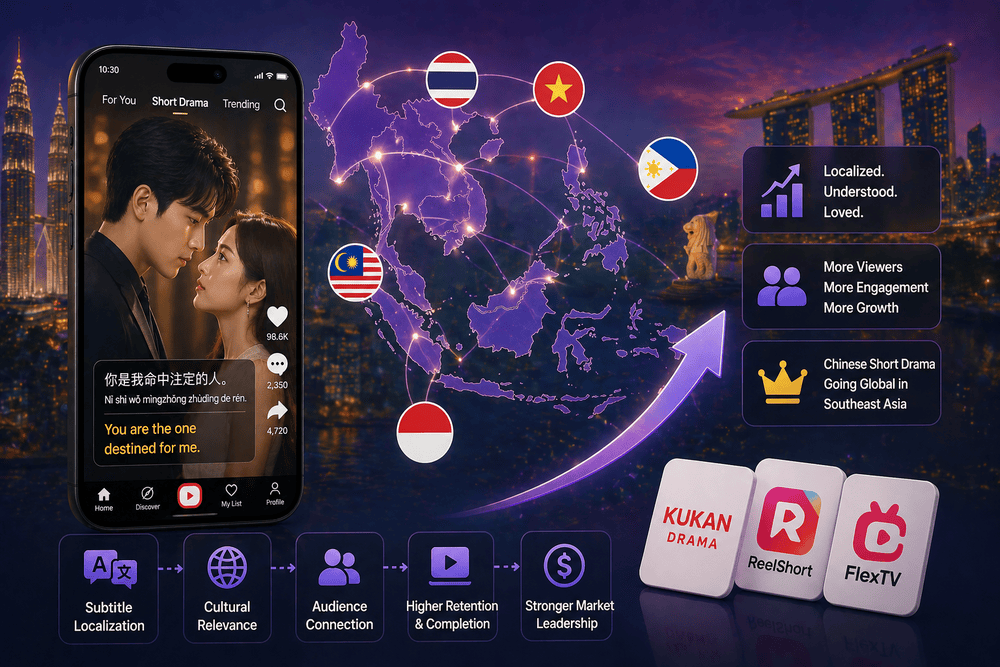
How Chinese Short Drama Platforms Are Winning Southeast Asia with Subtitle Localization
Chinese short drama platforms are rapidly gaining audience share across Southeast Asia by combining high-volume episodic content with fast, professional subtitle localization into the region's major languages. Platforms such as DramaBox, ReelShort, and Mango TV have demonstrated that localized short drama content, delivered consistently and at scale, can build substantial mobile audiences in markets where locally produced short-form content supply remains limited.
The competitive advantage these platforms hold is not primarily content quality or production budget. It is speed and localization infrastructure. By building systematic subtitle localization workflows that support simultaneous release across multiple Southeast Asian languages, Chinese short drama platforms have been able to move faster than both local competitors and Western streaming services in capturing mobile-first audiences in Indonesia, Thailand, Vietnam, the Philippines, and Malaysia.
For content platforms, streaming companies, and digital publishers evaluating their own Southeast Asian growth strategies, the Chinese short drama expansion model offers a clear and replicable framework, one built on localization as a core operational capability rather than an optional add-on.
Why Subtitle Localization Is Central to the Chinese Short Drama Expansion Model
Subtitle localization, the process of translating and culturally adapting dialogue text into target-language subtitles, is the primary mechanism through which Chinese short drama platforms have made their content accessible to Southeast Asian audiences who do not speak Mandarin.
Unlike dubbing, which requires significant production time and budget, subtitle localization can be produced at pace with high-volume episodic content release schedules. Chinese short drama platforms typically release content in daily or near-daily episode drops, a cadence that would be operationally impossible to sustain with full dubbing production. Subtitle localization, when supported by professional translation workflows, translation memory systems, and dedicated language teams, enables platforms to maintain that release pace across five or more Southeast Asian languages simultaneously.
The result is a content library that grows faster than competitors in local language formats, compounds audience engagement through habitual daily viewing, and establishes platform loyalty before locally produced alternatives can scale to match the volume.
Business Impact of Subtitle Localization for Short Drama Market Expansion in Southeast Asia
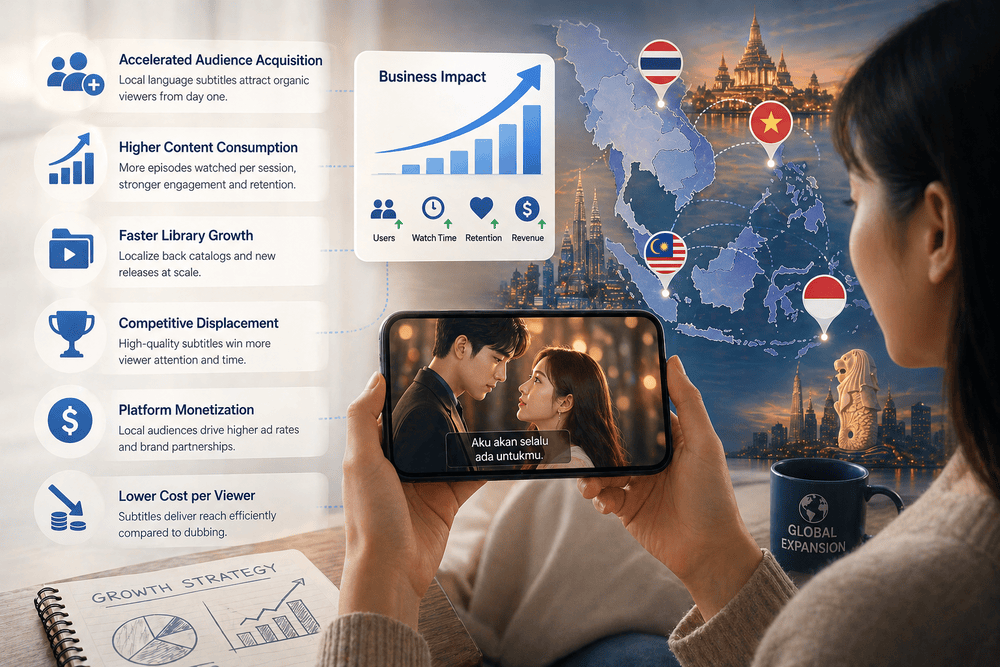
The success of Chinese short drama platforms in Southeast Asia provides concrete evidence of how subtitle localization directly drives platform growth metrics.
-
Accelerated audience acquisition in new markets: Localized content attracts organic viewers from target language markets from day one of release, without requiring paid acquisition spend to overcome a language barrier.
-
Higher content consumption per user: Viewers who can follow content in their native language watch more episodes per session, generating stronger engagement data that improves algorithmic recommendation and reduces the cost of audience retention.
-
Faster library growth in target languages: A scalable subtitle localization workflow allows platforms to localize back catalogs and new releases simultaneously, building a content depth that sustains subscriber interest and reduces churn.
-
Competitive displacement of unlocalized alternatives: In markets where competing content is available only in the source language or with lower-quality machine-translated subtitles, professionally localized content consistently captures a disproportionate share of viewer attention and time.
-
Platform monetization through localized audiences: Advertisers and brand partners in Southeast Asian markets pay significantly higher rates for inventory against local-language content because audience relevance and engagement are demonstrably higher.
-
Lower cost per viewer compared to dubbing: Subtitle localization delivers audience reach at a fraction of the production cost of dubbing, making it the most capital-efficient format for rapid multi-market expansion.
How Chinese Short Drama Platforms Build Subtitle Localization at Scale: The Operational Model
1. Establish Dedicated Language Teams for Each Priority Market
Rather than routing all Southeast Asian languages through a single generalist translation vendor, leading Chinese short drama platforms maintain dedicated translation and review capacity for each target language. This ensures that Bahasa Indonesia, Thai, Vietnamese, Filipino, and Malay subtitle outputs are each managed by teams with native fluency and format-specific experience.
2. Build Translation Memory Across the Content Library
Translation memory systems store approved translations of recurring dialogue, character-specific language, and show-specific terminology. For episodic short drama content—where characters use consistent speech patterns across dozens of episodes—translation memory dramatically reduces per-episode cost and turnaround time as the content library scales, while improving consistency across seasons and series.
3. Develop Series-Level Glossaries Before Episode Localization Begins
Before the first episode of a new series enters the localization pipeline, a controlled glossary is created covering character names, relationship terms, recurring phrases, and cultural references specific to that series. This glossary is distributed to all language teams and used as the authoritative reference for every episode, preventing the inconsistencies that undermine viewer continuity in episodic content.
4. Apply Cultural Adaptation Review at the Episode Level
Linguistic translation is reviewed by a native-language editor who assesses cultural accuracy, tonal appropriateness, and natural idiom for each target market. This step is what differentiates subtitle localization that retains viewers from subtitle translation that technically conveys meaning but feels foreign or awkward to native audiences.
5. Format Subtitles to Platform and Device Specifications
Mobile streaming platforms have distinct subtitle formatting requirements, including character limits per line, reading speed guidelines, timing offsets, and font rendering parameters. Chinese short drama platforms build these specifications into the localization workflow rather than applying them as a final correction step, ensuring that every language version renders correctly across the devices and platforms where target audiences consume content.
6. Maintain Simultaneous Multi-Language Release Capability
The defining operational advantage of the leading Chinese short drama platforms is the ability to release new episodes across five or more Southeast Asian languages on the same day as the source-language release. This simultaneous release model prevents the audience fragmentation and piracy risk that come with staggered regional rollouts and maximizes the algorithmic momentum of each new episode across all target markets at once.
7. Iterate Localization Quality Based on Audience Engagement Data
Platforms that treat localization as an ongoing optimization process, using viewer retention data, episode completion rates, and audience feedback by language market to identify and correct quality issues, consistently outperform those that treat localization as a one-time production step. Language-level engagement data reveals where subtitle quality is affecting viewer retention and where cultural adaptation may need refinement.
Common Mistakes Content Platforms Make When Replicating This Model
Underestimating the infrastructure required for simultaneous multi-language release. Releasing content in five Southeast Asian languages on a daily or near-daily basis requires dedicated language capacity, established workflows, and pre-built terminology resources, not ad-hoc translation procurement. Platforms that attempt to replicate the Chinese short drama release model without building the underlying localization infrastructure consistently fail to sustain the pace required.
Using machine translation as a cost-saving substitute for professional localization. The audience engagement advantage that Chinese short drama platforms have built in Southeast Asia is predicated on subtitle quality that feels natural to native-language viewers. Machine-translated subtitles are immediately recognizable to audiences and generate the viewer drop-off that erodes the algorithmic performance driving platform growth.
Applying a single subtitle style across all Southeast Asian markets. Each target language in the region has distinct formality conventions, humor registers, and cultural reference frameworks. Subtitles that are appropriate for Indonesian audiences may be tonally misaligned for Thai or Vietnamese audiences. Market-specific cultural adaptation is not optional for platforms competing for loyal local-language audiences.
Neglecting back-catalog localization in favor of new releases only. The content depth of a localized library is a significant driver of subscriber acquisition and retention. Platforms that localize only new releases while leaving an existing catalog in the source language lose the compounding audience growth that comes from new subscribers discovering and binge-watching older series in their native language.
FAQ
Why are Chinese short drama platforms growing faster than local competitors in Southeast Asia?
The primary structural advantage is content volume combined with localization speed. Chinese short drama platforms produce and localize content at a scale and pace that local competitors cannot currently match. By releasing multiple series simultaneously across five or more Southeast Asian languages, these platforms build library depth and daily engagement habits faster than any single-market competitor. Localization infrastructure, not content production quality alone, is the operational capability that makes this growth rate possible.
What makes subtitle localization more effective than dubbing for rapid market expansion?
Subtitle localization can be produced significantly faster and at lower cost than dubbing, making it operationally compatible with the high-volume, rapid-release content model that drives short drama platform growth. A professionally subtitled episode can be delivered in one to three business days; a fully dubbed version of the same episode requires substantially more production time and budget. For platforms prioritizing speed of market entry and library growth, subtitle localization is the more capital-efficient expansion format.
How do Chinese short drama platforms maintain subtitle quality across high content volumes?
Quality at scale is maintained through a combination of dedicated language teams, translation memory systems that ensure consistency across episodes, series-level terminology glossaries, and a structured cultural adaptation review process at the episode level. Platforms that invest in these infrastructure components early are able to sustain quality as content volume increases, rather than experiencing the quality degradation that comes with ad-hoc high-volume translation procurement.
Can smaller content platforms replicate this localization model without the resources of a large Chinese platform?
Yes, with the right localization partner. The operational model described above does not require an in-house localization department. Working with a professional localization partner that has dedicated capacity across Southeast Asian languages, established translation memory infrastructure, and experience in episodic content workflows gives smaller platforms access to the same operational capability at a scale appropriate to their content volume and market entry stage.
Building Your Southeast Asian Localization Infrastructure with a Professional Partner
For content platforms and short drama producers looking to replicate the market expansion success of leading Chinese streaming platforms in Southeast Asia, the foundational requirement is a localization infrastructure capable of delivering professional subtitle quality across multiple languages at the pace of your content release schedule.
Digital Trans Asia provides professional translation, interpretation, and localization services for businesses across Asia. With dedicated expertise across the major languages of Southeast Asia and direct experience supporting episodic content localization for streaming platforms and digital content distributors, Digital Trans Asia helps content businesses build the subtitle localization capability needed to compete and grow in the region's most valuable markets.
Conclusion
The expansion of Chinese short drama platforms across Southeast Asia is not a content story; it is a localization infrastructure story. The platforms winning audience share in Indonesia, Thailand, Vietnam, the Philippines, and Malaysia have built the operational capability to deliver professional subtitle localization across multiple languages simultaneously at the pace required to sustain daily content release schedules. For competing platforms and content producers, the lesson is clear: localization is not a production cost to be minimized. It is the market entry capability that determines how fast you grow, how deeply you retain viewers, and how effectively your content competes against both local alternatives and the Chinese platforms that have already established localized content libraries in your target markets.
Ready to expand your short drama platform across Southeast Asian markets with expert subtitle localization? Visit https://digital-trans.asia/ to learn more about our services. Contact us today to get started!