
Why Short Drama Platforms That Invest in Asian Market Localization Outperform Those That Don't
Short drama platforms that invest in professional localization for Asian markets consistently outperform those that don't across every metric that drives platform growth: audience acquisition, viewer retention, content engagement, and revenue per market. This is not a marginal advantage. It is a structural competitive gap that widens over time as localized platforms compound their audience data, library depth, and brand recognition in each target market while unlocalized competitors remain invisible to the majority of the addressable audience.
Localization converts content from a product that a small multilingual minority can access into a product that an entire market can engage with. In Asian markets where English and Mandarin literacy rates among the primary streaming demographic are limited, unlocalized content is effectively unavailable to the majority of potential viewers regardless of how compelling the production quality is.
For short drama platforms evaluating where to direct investment in order to accelerate growth across Asia, the evidence from markets already in play makes the business case for localization unambiguous. This article examines the specific reasons why localization creates measurable competitive advantages and what platforms that have not yet invested should expect if they continue without it.
What Asian Market Localization Means for Short Drama Platforms
Asian market localization for short drama platforms refers to the systematic process of adapting short-form episodic content into the languages and cultural contexts of target markets across Asia, including Southeast Asian markets such as Indonesia, Thailand, Vietnam, the Philippines, and Malaysia, as well as broader Asian markets including Japan, South Korea, and Taiwan.
Localization encompasses subtitle translation, cultural adaptation, dubbing where appropriate, on-screen text adaptation, and the technical formatting required to deliver content correctly across the devices and platforms used by audiences in each target market. It is distinct from simple translation in that it requires cultural adaptation, not just linguistic conversion, to produce content that engages native-language audiences at the same emotional level as the source-language original.
Why Localized Platforms Outperform: The Business Case by Growth Metric
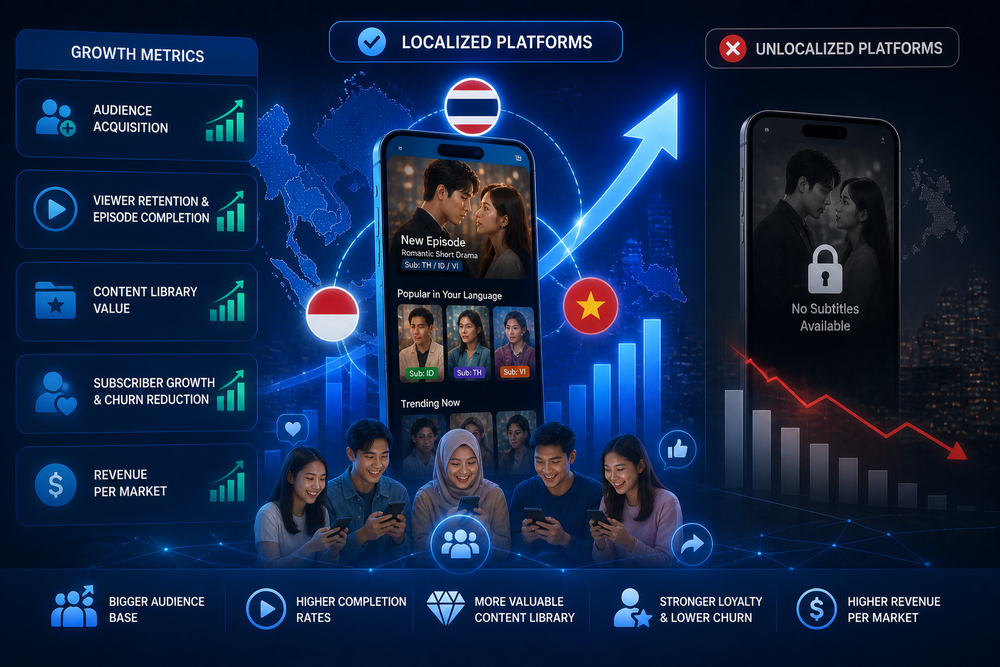
Audience Acquisition
Localized platforms can acquire audiences organically through search, social sharing, and word-of-mouth within native-language communities. Unlocalized platforms are excluded from this acquisition channel entirely. When a Thai viewer searches for short drama content on a streaming platform, content in Thai appears first in discovery results. Content without Thai subtitles or dubbing is algorithmically deprioritized and practically invisible to that viewer regardless of its production quality or marketing spend.
Viewer Retention and Episode Completion
Viewers who can follow content in their native language complete significantly more episodes per session than those who must consume content in a second or third language. Episode completion rate is one of the most important signals in streaming platform algorithms, determining which content is recommended to new users and how prominently existing content is surfaced in discovery feeds. Platforms with high completion rates on localized content benefit from compounding algorithmic amplification that unlocalized competitors cannot access.
Content Library Value
A localized content library grows in commercial value faster than an unlocalized one because each title becomes accessible to a substantially larger potential audience. A Chinese short drama series that has been professionally localized into Bahasa Indonesia, Thai, and Vietnamese can generate audience and revenue in three additional markets without any additional production cost. The localization investment is made once per title; the audience and revenue benefit compounds across the lifetime of the content in each market.
Subscriber Growth and Churn Reduction
Platforms that offer deep libraries of locally localized content build stronger subscriber loyalty than those relying on unlocalized imports. A subscriber who has established a daily viewing habit around a locally subtitled short drama series is significantly less likely to churn than one who has no native-language content anchor on the platform. Localization creates the conditions for habitual engagement, which is the primary driver of long-term subscriber retention.
Revenue Per Market
Advertising CPM rates, subscription conversion rates, and brand partnership values are all higher for platforms with demonstrated local-language audience engagement than for platforms with predominantly source-language viewership in a target market. Advertisers pay to reach audiences in the language those audiences respond to. Platforms without localization cannot offer this to local advertising partners, limiting their revenue ceiling in each unlocalized market.
How Localization Creates Compounding Competitive Advantages Over Time
-
Early market entry establishes audience habits. Platforms that localize and enter a market first build viewing habits among early adopters before competitors arrive. Once a viewer has established a daily content relationship with a platform, switching cost increases significantly even when competing alternatives become available.
-
Engagement data compounds algorithmic performance. Each episode a localized viewer completes generates engagement data that improves the platform's recommendation algorithm for that market. Platforms with more engagement data recommend content more accurately, which drives higher completion rates, which generates more data. Unlocalized platforms have no entry point into this compounding cycle.
-
Localized library depth deters competitive entry. A platform with two years of localized content across five Asian languages has built a library depth that a new entrant would need equivalent time and investment to replicate. Library depth is a durable competitive moat that protects market position against both new platform entrants and existing competitors that begin localizing later.
-
Brand recognition in local language markets builds organically. Platforms known for high-quality local-language content receive organic press coverage, social media discussion, and word-of-mouth referral in target markets. This earned brand recognition reduces paid acquisition costs over time and creates a self-reinforcing growth dynamic that unlocalized platforms cannot replicate.
-
Localization infrastructure improves with scale. Translation memory systems, series glossaries, and dedicated language teams become more efficient and cost-effective as content volume increases. Platforms that build localization infrastructure early benefit from declining per-episode costs and improving turnaround speed as they scale, while late entrants face the full infrastructure build cost at competitive disadvantage.
Common Mistakes Platforms Make When Avoiding or Delaying Localization Investment
Assuming paid marketing can substitute for localization. Paid acquisition campaigns in target Asian markets can drive installs, but they cannot drive retention if the content is not in the viewer's language. Platforms that spend on paid acquisition without localization investment consistently see high uninstall rates and low return-on-ad-spend in target markets.
Relying on multilingual minority audiences as a proxy for market penetration. Attracting the English-literate or Mandarin-literate minority in a Southeast Asian market is not equivalent to penetrating that market. The addressable audience for a platform with only Mandarin or English content in Indonesia, Thailand, or Vietnam is a fraction of the total market. Localization is the mechanism for accessing the majority.
Treating localization as a one-time project rather than an ongoing capability. Platforms that localize a small selection of titles to test market response and then pause investment do not build the library depth or audience habits required to establish market position. Localization is a continuous operational commitment, not a one-time market entry experiment.
Underestimating the quality gap between professional localization and machine translation. The viewer retention difference between professionally localized content and machine-translated content is significant and measurable in completion rate and churn data. Platforms that deploy machine translation as a cost-saving measure consistently underperform against competitors with professional localization in the same market.
Waiting for market proof before investing in localization. By the time a market shows clear proof of short drama demand, competing platforms with localization infrastructure already in place have established early-mover advantages that are difficult and expensive to overcome. Localization investment decisions should be made ahead of demonstrated demand, not in response to it.
FAQ
How significant is the performance gap between localized and unlocalized short drama platforms in Asian markets?
The performance gap is substantial and measurable across multiple metrics. Localized platforms in markets such as Indonesia and Vietnam report viewer retention rates that are significantly higher than unlocalized alternatives, episode completion rates that are consistently above platform averages, and organic audience growth that reduces paid acquisition dependency over time. The gap widens as localized platforms compound their engagement data advantage and library depth while unlocalized competitors remain excluded from native-language audience behavior.
Is localization worth the investment for platforms with limited content budgets?
Yes, particularly for platforms in the short drama format. Short drama content has lower per-episode production costs than long-form drama or film, which means the ratio of localization cost to content production cost is more favorable. Additionally, subtitle localization is significantly less expensive than dubbing and delivers comparable audience reach in most Southeast Asian markets. For platforms with limited budgets, prioritizing subtitle localization for the highest-opportunity market first and scaling from there is a more commercially effective allocation of resources than producing more unlocalized content.
Which Asian markets offer the highest return on localization investment for short drama platforms?
Indonesia consistently ranks as the highest-priority market for short drama localization based on audience size, mobile streaming growth rate, and demonstrated appetite for Chinese and Korean short drama content. Thailand and Vietnam are strong second-tier priorities with rapidly growing mobile streaming audiences and limited professionally localized short drama supply. The Philippines and Malaysia round out the primary Southeast Asian target markets. Japan and South Korea offer high-value but more competitive localization environments that typically suit platforms with established SEA market positions.
How long does it take for localization investment to show measurable returns?
Measurable returns from localization investment typically begin to appear within the first content release cycle in a new market. Platforms that release professionally localized content see immediate improvements in organic discovery, episode completion rates, and new user acquisition from the target language community from the first episode. Compounding advantages in library depth, algorithmic performance, and brand recognition build over a period of six to eighteen months of consistent localized content release.
Building the Localization Capability That Drives Platform Growth
For short drama platforms evaluating their investment priorities for Asian market expansion, the evidence from markets already in play is consistent: localization is the capability that determines which platforms grow and which ones remain marginal in each target market. The platforms winning in Indonesia, Thailand, and Vietnam today built their localization infrastructure before their competitors recognized the opportunity.
Digital Trans Asia provides professional translation, interpretation, and localization services for businesses across Asia. With dedicated expertise across the major languages of Southeast Asia and direct experience supporting streaming platforms and content distributors with episodic localization at scale, Digital Trans Asia helps short drama platforms build the localization capability required to compete and grow in Asia's most commercially valuable content markets.
Conclusion
Short drama platforms that invest in Asian market localization outperform those that don't because localization is the mechanism that converts content into audience, audience into engagement data, and engagement data into compounding competitive advantage. The gap between localized and unlocalized platforms in markets like Indonesia, Thailand, and Vietnam is not primarily a content quality gap. It is a market access gap. Localization closes that gap and opens the full addressable audience in each target market. Platforms that invest early build advantages in library depth, algorithmic performance, and brand recognition that are durable and difficult for later entrants to overcome. The question for short drama platforms evaluating their Asian market strategy is not whether localization delivers return on investment. The evidence in markets already in play answers that question clearly. The question is whether to invest now and build an early-mover advantage, or to wait and pay the higher cost of entering a market where competitors have already established localized content libraries and audience loyalty.
Ready to outperform competitors in Asian markets with expert short drama localization? Visit https://digital-trans.asia/ to learn more about our services. Contact us today to get started!