
How Website Localization Drives Global Business Growth
Website localization is more than just translation. It is a business tool for international expansion that makes digital products accessible and appealing to local audiences by translating not only the content, but also the design, the layout, and the functional elements in accordance with local language, culture, and technical standards.
What Is Website Localization and Why Is It Important?
Website localization goes beyond simple translation techniques. It is not just about converting the written content of the site from one language into another but about making the entire digital interaction and customer-facing aspect fit for a particular market, including the local currency, the date formats, payment systems, a company's compliance with local law, images, and even the design and layout of the website.
In fact, a business website today is considered the gateway through which most customers will engage with the company, even globally. If the sole language on your English-only or single-language site is what you rely on to reach global markets, you are literally shutting out your business growth from a large portion of those potential customers.
Search engines are more likely to show web pages in languages that local users have asked to see. That is why having versions of your website in different languages is a very important component in getting your website visible to people around the world.
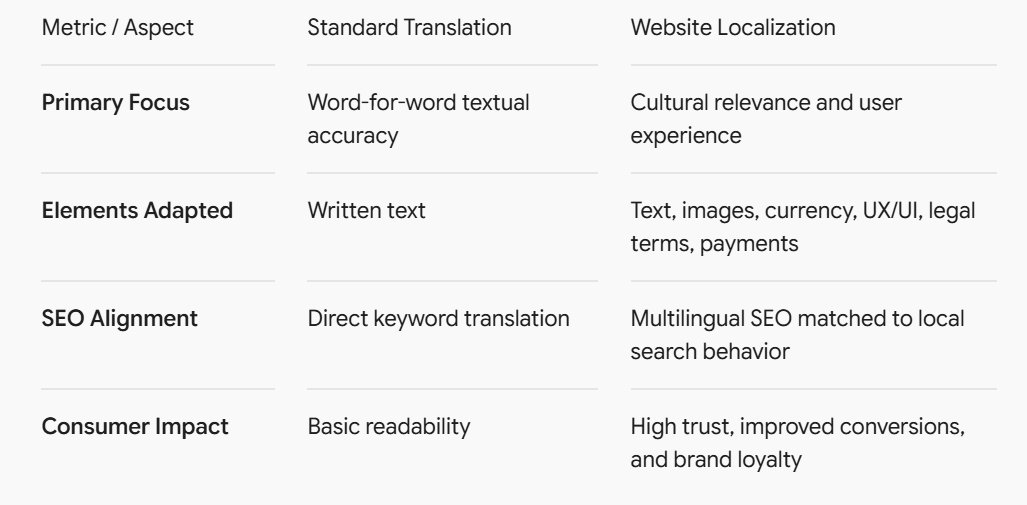
Businesses can increase their market reach and sales by changing the language, cultural references, design, etc., of their website so that the end customers get a comfortable, customized experience. Buyers typically prefer buying things, comparing products, or getting information in the language they speak at home or where they are from.
The main factor behind the use of a specific language for doing business across the world is therefore translation and localization, which make the content accessible.
Also read: Machine Translation vs Human Translation: Which Is Better for Game Localization?
Business Benefits of Website Localization
Executing a well-planned localization strategy yields measurable returns across sales performance, search engine visibility, customer acquisition costs, and brand equity in new international markets.
Higher Conversion Rates and Revenue Growth
Consumers are far more likely to complete a purchase when the entire sales funnel—from product descriptions to checkout portals—reflects their language, local currency, and preferred payment systems.
A benchmark study by CSA Research surveying 8,709 global consumers across 29 countries revealed that 76% of online shoppers prefer purchasing products with information presented in their native language. Even more telling, 40% of consumers stated they will never make a purchase from websites operating in foreign languages.
Expanded Global Market Reach
Adapting your web infrastructure opens direct access to rapidly expanding digital economies across Asia, Latin America, and Europe. According to data from Nimdzi Insights, the global language services market is projected to reach over $75 billion, underscoring the enormous corporate investment in reaching localized audiences. By establishing regional language offerings, brands effectively capture untapped market segments that competitors relying on single-language websites miss.
Improved Multilingual SEO Performance
Search engines aim to deliver the most relevant localized results to users worldwide. Localizing your URL structures, subdomains, subdirectories, metadata, and body copy allows search engines like Google, Baidu, and Yandex to index your content accurately. This targeted optimization ensures your brand ranks higher for high-intent regional search queries, bringing scalable organic traffic to your international domains.
Reduced Bounce Rates and Longer Dwell Time
Online visitors quickly abandon web pages that present unnatural phrasing, awkward machine translation, or confusing foreign checkout procedures. A fully localized digital platform keeps visitors engaged longer, reducing overall bounce rates and increasing key engagement metrics like pages per session and average session duration.
Also read: What Does a Localization Company Do? A Beginner's Guide
How Website Localization Works

Implementing an effective localization program requires a structured technical and linguistic workflow.
- Market Selection and Strategy: Analyze web traffic, demographic data, and market demand to prioritize target languages and geographic regions.
- Internationalization (i18n): Architect the website codebase to support multi-language frameworks, right-to-left (RTL) scripts, non-Latin character sets (UTF-8), and dynamic UI expansion.
- Content Extraction: Export copy, dynamic strings, and multimedia assets into structured file formats compatible with translation management systems (TMS).
- Linguistic and Cultural Adaptation: Native linguists translate and adapt tone, context, and terminology to maintain brand integrity while resonating locally.
- Multilingual SEO Optimization: Perform local search volume research to optimize page titles, meta descriptions, alt tags, and headers for regional search engines.
- Quality Assurance and Testing: Test functional workflows, payment gateways, visual layouts, and character displays across devices prior to deployment.
- Launch and Automation: Deploy localized sites and configure automated sync workflows to publish new core site updates seamlessly in all target languages.
Common Mistakes and Challenges in Localization
Expanding an enterprise web platform globally introduces complex technical, operational, and cultural challenges. Avoiding these critical pitfalls ensures maximum ROI and accelerated market adoption.
Over-Relying on Unedited Machine Translation
While raw machine translation offers rapid speed, relying entirely on automated output without professional oversight routinely causes embarrassing errors, loss of brand tone, and nonsensical product details. Combining automated technology with human post-editing guarantees both speed and linguistic precision.
Neglecting Technical Infrastructure
Translating copy into languages such as German or Finnish often expands text length by 20% to 30%, whereas Arabic and Hebrew read from right to left. Websites built without flexible layout containers and internationalized code inevitably suffer from broken buttons, overflowing text blocks, and disrupted site navigation.
Disregarding Regional Visuals and Cultural Context
Images, icons, color schemes, and symbols carry distinct cultural meanings across different geographic regions. Visual campaigns that convert well in Western markets may confuse or offend audiences in Asian or Middle Eastern territories. All media assets should be thoroughly evaluated alongside textual content.
Omitting Preferred Local Payment Gateway Integration
Restricting checkout options strictly to international credit cards creates massive cart abandonment in regions where digital e-wallets, direct bank transfers, or local payment apps dominate the market landscape.
Partnering with a specialized localization provider helps organizations navigate these engineering and cultural hurdles efficiently. Established service partners construct continuous translation pipelines, keeping dynamic content synchronized across all international markets without straining internal team resources.
Also read: Which Documents Still Require Professional Translation in the AI Era?
FAQ
What is the primary difference between translation and website localization?
Translation involves converting text directly from one language into another. Localization goes further by adapting the complete user experience—including currencies, payment gateways, legal statements, visual elements, and UI design—to fit local cultural and technical norms.
How much does a comprehensive website localization project cost?
Project costs depend heavily on total word count, the number of target languages, platform architecture complexity, dynamic content volume, and industry-specific technical requirements.
Which languages should a business target first for global growth?
Identify target languages by analyzing your current international web traffic, customer demographics, competitor market shares, and foreign revenue opportunities using web analytics platforms.
How long does it take to fully localize a business website?
Standard corporate websites typically require three to six weeks for complete localization, whereas high-volume e-commerce platforms with dynamic product inventories rely on continuous integration workflows.
How does website localization improve global organic SEO?
Localization enables major search engines to index dedicated, native-language URLs and localized metadata, helping your website rank for specific search queries typed by regional users.
What is internationalization (i18n) in web development?
Internationalization is the frontend and backend engineering process of designing software code so it can easily host multiple languages, character sets, and regional settings without requiring structural code re-engineering.
Can automated machine translation replace human translation entirely?
Machine translation serves well as an initial draft generator, but professional human specialists are necessary to review, refine, and verify cultural nuance, technical precision, and overall brand voice.
How can companies accurately measure the ROI of localization?
Track essential performance indicators including regional organic traffic expansion, bounce rate improvements, localized conversion rates, average order values, and total revenue growth in target markets.
Conclusion
Successfully scaling into global markets demands far more than simple literal translation. A comprehensive website localization strategy ensures your organization communicates authentically with regional audiences, builds lasting brand authority, and drives sustainable revenue growth across every target territory. By aligning web design, functional features, and messaging with local user expectations, companies turn raw international traffic into loyal, long-term customers.
Digital-Trans Asia provides professional translation, interpretation, and localization services for businesses across Asia.
Ready to expand your digital presence internationally? Partner with seasoned localization specialists today to build an authentic, high-converting digital experience in every market you target.