Get to Know the Similar English Words in Thailand
If you have ever visited Thailand or chatted with the locals, you might notice something interesting: many Thai words sound surprisingly familiar to English speakers. These similar English words in Thailand are not just coincidences. They tell stories about cultural exchange, globalization, and the evolution of language in a modern way.
Moreover, Thailand is well-known for its colorful traditions, warm hospitality, and distinct language. Beyond its unique alphabet and tone-based pronunciation, Thai also embraces many English words, adapting them to local speech patterns. Whether you’re walking through the busy streets of Bangkok, ordering food in Chiang Mai, or scrolling through Thai social media, you’ll often hear English-origin words seamlessly mixed into Thai conversations.
This fascinating mix of languages reveals how deeply English has influenced Thai society in education, technology, business, and entertainment. Let’s dive deeper into why and how these similar English words in Thailand exist and how they make communication easier for visitors and locals alike.
Why Similar English Words Exist in Thai Language
The presence of similar English words in Thailand can be traced back to globalization and modernization. On the other hand, English is the international language of science, business, and pop culture, and Thailand—like many countries in Asia—adopted foreign terms to keep up with global trends.
As Thailand developed its economy and opened up to international trade, education, and tourism, English words began entering the Thai vocabulary. However, Thais rarely use them exactly as they are spoken in English. Instead, they adapt English words to Thai phonetics, resulting in a set of words that sound “English-like,” but carry a distinctly Thai flavor.
For instance, the English word computer becomes คอมพิวเตอร์ (kom-piu-ter), and internet becomes อินเทอร์เน็ต (in-thoe-net). The pronunciation may differ slightly, but the meaning remains the same. These adaptations make it easier for Thais to integrate foreign terms into their language system, maintaining fluency while embracing modernity.
Examples of Common Similar English Words in Thailand
Let’s look at some of the most common examples of similar English words you’ll encounter in Thailand. These words have become so common that many Thais might not even realize they originated in English.
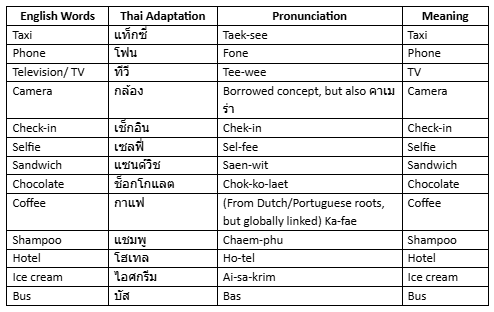
Many of these words are used daily, especially in cities and tourist areas. The pronunciation might differ slightly due to Thai tonal patterns, but their English roots remain recognizable to foreigners.
The Influence of English on Modern Thai Communication
The use of similar English words in Thailand reflects how society adapts to the global era. English influence can be seen across three major areas, as follows:
a. Technology and Media
Most Thai people use English terms for technology-related vocabulary. Words like “Facebook,” “YouTube,” “Google,” and “Wi-Fi” are pronounced in a Thai accent, but used exactly as they are in English. Meanwhile, in Thai advertising, tech blogs, and even news reports, you’ll hear these words mixed into otherwise Thai sentences.
For example:
“โพสต์ในเฟซบุ๊ก” (post nai Facebook) means “post on Facebook.”
“อัปโหลดคลิปในยูทูบ” (upload clip nai YouTube) means “upload a clip on YouTube.”
These phrases show how Thai speakers naturally code-switch between Thai and English.
b. Education and Business
English is widely taught in Thai schools and is considered a key skill for career advancement. In business meetings, especially in multinational companies, Thai professionals often use English technical terms like marketing, strategy, project, and presentation.
Even in Thai-only workplaces, English jargon often sneaks into daily communication:
“ไปมีตติ้ง” (pai meeting) – “Go to a meeting.”
“ส่งรีพอร์ต” (song report) – “Send a report.”
c. Pop Culture and Lifestyle
English has also shaped Thai pop culture. Words related to fashion, beauty, and lifestyle often come straight from English, even sometimes with creative twists. You’ll hear terms like แฟชั่น (fashion), เทรนด์ (trend), สไตล์ (style), and เมกอัพ (makeup).
Many Thai celebrities and influencers also blend English expressions with Thai captions on social media, such as “วันนี้ฟีลกู้ดมาก!” (Today feels good mak equivalent to “I feel so good today!”).
How English Words Are Adapted to Thai Pronunciation
The Thai language has its own set of sounds, tones, and syllable patterns. When adopting English words, Thais modify pronunciation to fit the Thai phonetic system. Here are a few common patterns:
Adding vowels: Thai words cannot end in consonant clusters like “-st” or “-nd,” so extra vowels are added. For example, bus becomes บัส (bas), and sandwich becomes แซนด์วิช (saen-wit).
Replacing unavailable sounds: Thai doesn’t have the “th” sound, so theater might become เธียเตอร์ (thee-a-ter).
Tone adjustments: Every Thai word carries a tone (high, low, rising, falling, or mid), so borrowed English words are given tones to fit naturally into Thai speech.
This process results in words that sound close enough to their English origins to be recognizable, but comfortable enough for Thai speakers to pronounce and use daily.
Similar English Words in Everyday Thai Life
You’ll find similar English words in Thailand everywhere, from shopping malls and menus to conversations and advertisements. To demonstrate this point, kindly scroll down.
In Daily Speech
English-origin words help bridge communication gaps between generations and even with tourists. For instance, a Thai vendor might say, “มีโปรโมชั่นค่ะ” (mee promotion kha) meaning “There’s a promotion,” or “เช็กอินตรงนี้ค่ะ” (check-in trong nee kha) meaning “Check in here.”
In Signage and Advertising
English and Thai often coexist on billboards, store signs, and menus. You might see phrases like “Happy Hour,” “Best Seller,” or “Super Sale” written alongside Thai text. This bilingual style makes it easier for international visitors and reflects the growing global identity of Thailand’s urban culture.
In Social Media
Social media is a major space where language mixing thrives. Thai users often combine English and Thai for aesthetic or expressive purposes. A caption might read:
“Mood today: Chill vibes only ชีวิตต้องเบาๆ หน่อย!” equivalent to “Mood today: Chill vibes only. Life needs to be lighter sometimes!”
The Cultural Meaning Behind Borrowed English Words
These similar English words in Thailand are more than borrowed vocabulary since they represent cultural openness and flexibility. Thais are known for being adaptable. Thus, this is reflected in how they incorporate English into daily life.
Moreover, borrowed English words often carry a sense of modernity, sophistication, or global connection. Using them can make speech sound trendy or cosmopolitan, especially among younger generations. At the same time, Thailand manages to keep its linguistic identity strong, showing that borrowing doesn’t mean losing one’s roots but rather expanding expression.
How Learning Similar English Words Helps Travelers
If you’re visiting Thailand, recognizing these similar English words can boost your experience and make it more enjoyable. You’ll understand menus, signs, and conversations easily. For instance:
Ordering food? Look for “เบอร์เกอร์ (burger)” or “พิซซ่า (pizza).”
Taking transport? Ask for a “แท็กซี่ (taxi)” or “บัส (bus).”
Shopping? You’ll see “โปรโมชั่น (promotion)” and “เซลล์ (sale)” signs everywhere.
These familiar-sounding words are comforting bridges between languages, helping travelers connect more naturally with locals.
The Future of English Influence in Thai Language
Furthermore, as globalization continues, it’s likely that more English words will enter Thai vocabulary. However, Thai people will continue to adapt and reshape them to fit local usage. Linguists call this process “Thai English” or “Tinglish” (Thai + English), a hybrid language that reflects modern Thailand’s cultural dynamism.
Interestingly, this blending also happens in reverse—Thai words like pad thai, tom yum, and muay thai have become globally recognized, showing that language exchange works both ways.
Conclusion
The growing number of similar English words in Thailand beautifully illustrates how languages evolve through contact and creativity. English loanwords enrich Thai vocabulary without erasing its identity, blending the local and the global into a living example of linguistic harmony.
For language learners, travelers, and culture lovers, these shared words are a reminder that communication isn’t just about grammar—it’s about connection. Whether you say “kom-piu-ter” or “computer,” what truly matters is understanding and being understood.
So next time you’re in Thailand, listen closely. You’ll hear echoes of English everywhere, from café menus to friendly greetings, and you’ll realize that languages, just like people, are never separate. They grow together, evolve together, and bridge worlds through shared words.