
How Language Services Prevent Costly Failures in Global Live Games
Global live games operate in a fast-moving ecosystem where updates happen continuously, player communities evolve rapidly, and cultural expectations vary across regions. Unlike traditional single-release titles, live service games require ongoing communication, localization, and player engagement strategies that adapt in real time.
As gaming becomes increasingly international, language is no longer merely a translation task. It has a critical operational function. Many global game launches fail not because of poor gameplay, but due to miscommunication, cultural misunderstandings, or inadequate localization strategies.
This is where language services play a crucial role. By ensuring clarity, cultural relevance, and seamless communication across markets, language services help prevent costly mistakes that can damage player trust, revenue, and brand reputation. Read on to explore how these services safeguard global expansion.
Definition and Explanation: Language Services in Global Live Games
Language services refer to professional solutions designed to help companies communicate across multiple languages and cultures. In the 2026 gaming landscape, these services transcend basic translation and include localization, cultural adaptation, multilingual customer support, and real-time communication strategies.
For global live games, such as MMORPGs, online shooters, mobile live service titles, and esports-driven platforms, language services are essential since the product evolves continuously after launch. New updates, events, patches, and player interactions require ongoing communication across diverse audiences. Meanwhile, key components of language services in live gaming include:
- Localization: Adapting in-game content, UI, dialogue, and marketing materials to different languages and cultures.
- Transcreation: Rewriting content creatively to maintain emotional impact across cultures.
- Localized Community Management: Ensuring player-facing announcements, patch notes, and moderation reflect local expectations.
- Multilingual customer support: Providing assistance to players in their native language.
- Live content adaptation: Rapid translation and cultural review of seasonal events, promotions, and updates.
Unlike static translation workflows, global live games require agile and scalable language solutions. A delayed or poorly localized update can quickly cause confusion, negative reviews, or player disengagement.
Benefits and Use Cases of Language Services in Global Live Games
Language services provide strategic advantages that extend beyond communication accuracy. They directly impact player retention, market expansion, and operational efficiency. Strategic benefits of integrated language services include:
Consistent player experience across regions
Proper localization ensures that players receive the same emotional and gameplay experience regardless of language or culture.
Faster global updates and synchronized releases
Live games often launch updates simultaneously worldwide. Language services enable parallel localization workflows to prevent regional delays.
Improved player retention and engagement
Players feel more connected when content reflects their language, humor, and cultural context.
Reduced community backlash
Cultural sensitivity reviews prevent unintended offense or misinterpretation that could trigger social media controversies.
Localized live events and seasonal campaigns
Events tailored to regional preferences increase participation and monetization opportunities.
Multilingual live support and moderation
Language services help community managers respond quickly to player concerns, reducing frustration and churn.
Effective global marketing campaigns
Transcreation ensures marketing messages resonate emotionally rather than sounding like literal translations.
Compliance with regional regulations
Accurate localization helps meet legal requirements such as age ratings, disclaimers, or consumer protection rules.
In a practical, real-world context, a live game launching a seasonal event in multiple regions may require adapted dialogue, different humor styles, adjusted character references, and region-specific promotions. It will be all coordinated through language services.
How Language Services Work: Process for Global Live Games
Implementing language services effectively requires a structured process aligned with live operations workflows. While specific approaches vary, the general process includes the following steps:
Content Planning and Internationalization
Developers prepare content with localization in mind, decoupling text strings and ensuring UI reflow capabilities. This stage prevents technical issues later.
Glossary and Style Guide Creation
Language experts define terminology, tone, and character voice to maintain consistency across updates and languages.
Localization and Transcreation
Linguists adapt text, dialogue, marketing materials, and player-facing communications. Cultural nuances are addressed during this phase.
Linguistic Quality Assurance (LQA)
Localized content is reviewed within the game environment to verify accuracy, layout compatibility, and gameplay clarity.
Live Deployment Synchronization
Language teams coordinate with live operations teams to release updates simultaneously across regions.
Community Feedback Monitoring
Player responses are analyzed to identify misunderstandings or cultural friction that may require quick revisions.
Continuous Optimization
Language services evolve alongside the game, refining tone, terminology, and communication strategies based on analytics and player behavior.
After all, this iterative process allows studios to respond quickly while maintaining high-quality communication standards across global audiences.
Common Mistakes and Risks in Global Live Game Localization
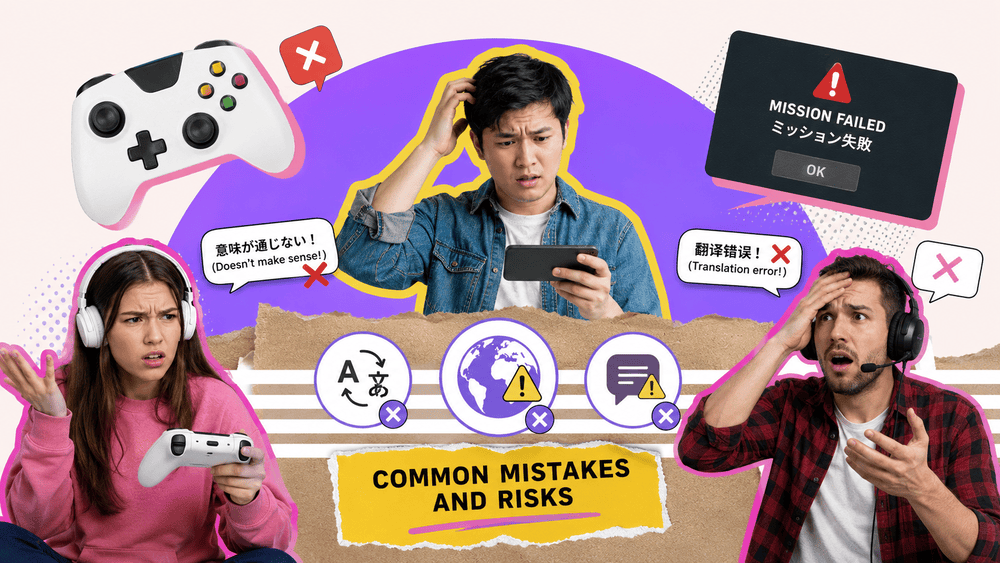
Despite the growing importance of language services, many studios still underestimate the complexity involved in global live game localization. A primary pitfall is treating localization as an afterthought rather than integrating it early into development, which often results in rushed translations and technical complications.
Moreover, another frequent mistake is relying on literal translation without proper cultural adaptation, causing humor, tone, or context to be lost and leading to confusing player experiences. Some teams also overlook regional communication preferences, failing to adjust tone or style to suit different audiences, which can unintentionally alienate players.
Inconsistent terminology across updates further creates confusion, particularly when gameplay mechanics or key features are described differently over time. Delayed localization for live updates is another risk, as players in certain regions may feel excluded when content is released later than in other markets.
Additionally, underestimating the need for multilingual customer support can quickly escalate frustration and damage community trust. While automated translation tools can help streamline workflows, over-reliance on them without human oversight often compromises accuracy and cultural sensitivity. When these challenges are not properly addressed, they can result in negative reviews, decreased engagement, and even the loss of important global markets.
Are Language Services Different from Basic Translation?
Language services go far beyond basic translation. While translation focuses primarily on converting text from a source language into a target language, language services involve a broader strategic approach to global communication. This includes localization strategy, cultural adaptation, transcreation (creative rewriting to preserve emotional impact), multilingual customer support, and ongoing content management across different regions.
In the context of global live games, language services also ensure consistency in terminology, character voice, and gameplay messaging across updates. They help align communication with cultural expectations, player behavior, and regional market preferences. In short, translation is one part of a larger ecosystem designed to deliver seamless and culturally relevant player experiences worldwide.
Why Are Language Services Especially Salient for Live Service Games?
Language services are particularly critical for live service games as these titles operate in a constantly evolving environment. Unlike traditional games with fixed content, live games regularly release patches, seasonal events, new characters, balance changes, and community announcements. Each update requires accurate and culturally appropriate communication to avoid misunderstandings.
Furthermore, poorly localized patch notes, unclear event descriptions, or culturally insensitive messaging can quickly trigger confusion or backlash, especially since global player communities react instantly through social media and forums. Effective language services allow studios to maintain synchronized global launches, preserve narrative consistency, and ensure that players across different regions receive the same quality of experience.
Can Small Studios Benefit from Professional Language Services?
Language services are not only for large AAA studios; smaller teams can gain significant advantages by integrating scalable language workflows early in development. By planning localization from the start, indie developers can avoid costly rework, prevent technical limitations related to UI or text expansion, and streamline future updates.
Professional language services also help smaller studios build credibility in international markets, making their games feel polished and accessible from day one. Even with limited budgets, strategic use of language services, such as prioritizing key markets or implementing flexible localization pipelines, can greatly improve player reception and reduce risks during global launches.
Do Language Services Improve Monetization?
Effective language services can directly impact monetization by improving player engagement and trust. Players are more likely to participate in events, purchase in-game items, or respond to promotional campaigns when messaging feels natural, culturally relevant, and easy to understand. Localized marketing content, culturally adapted storytelling, and clear communication about rewards or mechanics reduce friction and encourage participation.
Additionally, language services help prevent misunderstandings that might otherwise lead to negative reviews or refund requests. Over time, well-executed localization builds stronger player loyalty, which contributes to higher retention rates and increased lifetime value for global audiences.
In accordance, Digital-Trans Asia provides professional translation, interpretation, and localization services for business across Asia. Launching a live game globally comes with constant updates and ever-evolving player expectations. The professional team helps you deliver every patch, event, and community message clearly and culturally relevant across all regions, reducing costly mistakes and boosting player engagement. Reach out today to make your game seamless for players worldwide.
Conclusion
Global live games operate in a dynamic environment where communication is constant and player expectations vary widely across regions. Language barriers and cultural misunderstandings can quickly turn into costly failures, affecting player retention, brand reputation, and revenue.
By investing in professional language services, studios can ensure that every patch, event, and interaction resonates locally and engaging regardless of language. From synchronized global launches to culturally adapted marketing campaigns, language services enable developers to build inclusive communities and maintain consistent experiences worldwide.
As the gaming industry continues to expand globally, language services are no longer a luxury; they are a strategic necessity for any live game aiming to succeed on an international stage.
Ready to protect your global live game with professional language services across Asia? Visit https://digital-trans.asia/ to learn more about our services. Contact us today to get started!