Why Lore Matters in Game Localization and How to Get It Right?
Localization is a fixed price in the global gaming industry since it is a strategic must. However, many studios only focus on translating voice lines or UI text. Lore is an essential aspect that is often overlooked, whereas it is a part of immersion in games that are based on stories. If localization is done wrong, it can turn players off, change the meaning of the game, and even hurt its success in other countries.
This article talks about why lore is crucial for game localization, how it affects success around the world, and how to do it right.
What Is Lore in Game Localization?
Game localization is the process of adapting a video game for different regions, languages, and cultures beyond its original market. This includes translating text, altering cultural references, modifying visuals, and ensuring compliance with local regulations.
However, localization goes far beyond literal translation. It involves what professionals call transcreation—recreating meaning, tone, and emotional impact for a new audience.
Lore, on the other hand, is the deep story structure that presents a game's identity and meaning. It includes the complex world-building to set the scene, the character backstories to give each interaction emotional weight, and the cultural systems to control how societies in the game work.
Lore also includes the universe's mythology, history, and basic rules. These are things that make the story believable and consistent. These elements work together to create a strong narrative foundation, allowing players not only to engage with the game but also to fully immerse themselves in its world and understand the stakes, conflicts, and motivations that drive the experience.
When these two intersect, lore-driven localization becomes one of the most complex yet crucial aspects of global game development. A mistranslated line is not merely a linguistic issue, as it can distort character motivations, alter plot meaning, or confuse entire story arcs.
This complexity is reflected in industry practice. For instance, large-scale games like Cyberpunk 2077 required translating over 1.1 million words into 19 languages, with thousands of contributors involved in localization alone.
The Benefit of Lore in Game Localization
When lore is properly handled in game localization, the benefits are both creative and commercial as follows:
- Deeper player immersion: Players connect emotionally when the story feels natural in their language and culture.
- Higher player retention: Narrative clarity keeps players engaged longer, especially in lore-heavy games.
- Expanded global reach: Localization opens access to non-English-speaking markets, which represent over 60% of the global gaming population.
- Increased sales and revenue: Localized games can perform 15%–40% better than English-only versions.
- Stronger market penetration: Top non-English markets contribute about 50% of global gaming revenue, making localization essential for growth.
- Improved player satisfaction: Around 58% of gamers are more likely to purchase a game in their native language.
- Better reviews and community engagement: Accurate lore translation leads to stronger fan communities, fan art, and discussions.
- Cultural resonance: Properly adapted lore ensures the game feels "native" rather than foreign.
How Lore in Game Localization Works?
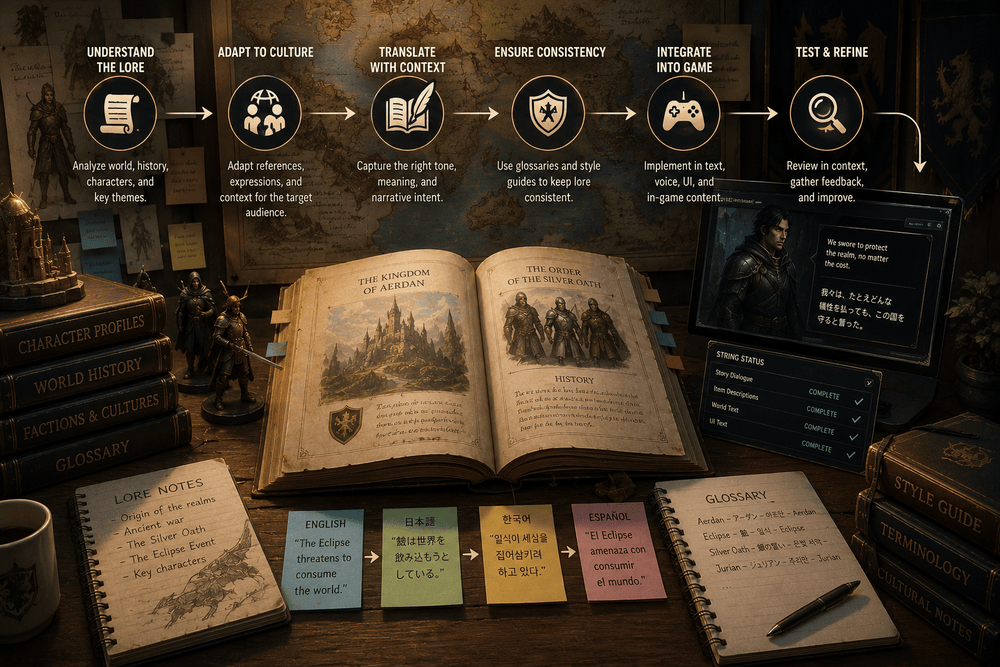
Successfully localizing lore requires a structured and collaborative process. Here is how it typically works:
1. Lore Analysis and Documentation
Before translation begins, the team compiles a lore bible to ensure consistency across languages.
- Character profiles
- World rules
- Terminology glossary
- Timeline of events
2. Contextual Translation (Not Literal)
Translators work with the full context. Without this, even simple lines can be misinterpreted.
- Who is speaking?
- What is the emotional tone?
- What is happening in the scene?
3. Terminology Management
Key lore terms (e.g., magic systems, factions, artifacts) must remain consistent
- Create approved translations
- Maintain a centralized glossary
- Avoid inconsistent naming across regions
4. Cultural Adaptation
Certain lore elements may need adaptation. For instance, some games replace culturally specific references with locally recognizable ones to improve understanding.
- Mythological references
- Humor and idioms
- Symbolism and taboos
5. Integration Into Game Assets
Localization is not simply text since it all must align with the localized lore.
- Voice acting
- UI elements
- Subtitles
- Cinematics
6. Quality Assurance (QA)
Localization QA includes three aspects. Teams often replay the game multiple times to ensure everything fits seamlessly.
- Linguistic accuracy
- Lore consistency
- Gameplay clarity
7. Iteration and Updates
Localization continues post-launch, and lore must remain consistent across all updates.
- DLC content
- Patches
- Seasonal events
Common Mistakes of Lore in Game Localization
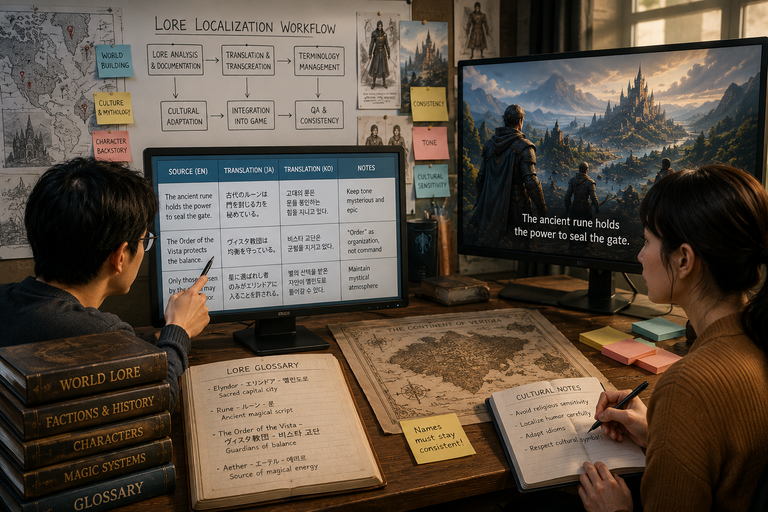
Even experienced studios can encounter challenges when localizing lore, as the process involves more than simply converting words from one language to another. One of the most common pitfalls is treating localization as straightforward translation, where literal interpretations overlook tone, cultural nuance, and narrative depth, ultimately resulting in awkward or unclear storytelling.
Another issue arises when translators lack sufficient context—working with isolated text, such as spreadsheets, can lead to misinterpretation, especially in dialogue that is deeply tied to the game's lore.
Inconsistency in terminology is also a frequent problem, as changing names or key terms across languages can confuse players and disrupt immersion. Additionally, ignoring cultural sensitivity can cause certain themes, symbols, or narrative elements to feel out of place or even offensive in different regions.
Some studios also underestimate the complexity of lore itself; games with rich narrative structures, such as RPGs, require specialized localization approaches, and poor execution can easily break player immersion.
Finally, while machine translation tools can improve efficiency, relying on them too heavily often results in a loss of nuance, tone, and narrative intent, which are essential for preserving the integrity of the game's story.
Why Is Lore More Difficult to Localize than Regular Text?
Lore is inherently more complex because it carries layered meaning that goes far beyond surface-level language. It includes historical context, emotional nuance, symbolism, and internal consistency across the game's universe.
Unlike UI text or simple instructions, lore is deeply interconnected—characters, events, and world rules often reference one another. This means a single mistranslation can create inconsistencies, alter character motivations, or even contradict established storylines.
In lore-heavy games, translators must understand not only the language but also the narrative intent behind every line, making the process significantly more demanding and detail-oriented.
Can Poor Lore Localization Really Impact Sales?
Poor lore localization can have a direct and measurable impact on a game's commercial performance. When players struggle to understand the story or feel disconnected due to awkward or inaccurate translations, their overall experience suffers.
This often leads to negative reviews, lower player retention, and reduced word-of-mouth promotion. On the other hand, well-localized games feel natural and immersive, encouraging players to stay engaged and recommend the game to others.
Research consistently shows that players are more likely to purchase and enjoy games in their native language, meaning that high-quality localization—including lore—can significantly expand a game's reach and revenue potential.
What Is the Difference between Translation and Transcreation?
Translation focuses on converting text from one language to another as accurately as possible, often prioritizing literal meaning and grammatical correctness. Transcreation, however, goes a step further by adapting the content to preserve its original tone, emotion, and cultural relevance for a new audience.
This is especially important in lore-heavy games, where dialogue, symbolism, and storytelling must resonate with players across different cultures. Transcreation allows translators to reinterpret phrases, idioms, or references so they feel natural and impactful, ensuring that the story delivers the same experience—emotionally and narratively—regardless of language.
Accordingly, Digital-Trans Asia provides professional translation, interpretation, and localization services for businesses across Asia. Handling lore in game localization requires more than linguistic accuracy since it calls for a deep understanding of narrative, culture, and player experience.
That is why working with professional language services can make a meaningful difference, especially for story-driven games where every detail matters. With experienced linguists and structured localization workflows, you can ensure that your game's world-building, character depth, and emotional tone remain intact across languages.
Meanwhile, for developers, it can approach localization with greater confidence—knowing that complex lore elements are handled with care, consistency, and cultural sensitivity. In the long run, it helps your game resonate more strongly with global audiences.
Conclusion
Lore is more than another part of game design, as it is the emotional and story-based foundation that shapes how players feel about a game. For game localization, keeping this foundation is a salient business goal.
As the global gaming audience becomes more diverse, with most players coming from non-English-speaking areas, localization can no longer be an afterthought. It has become a necessary part of getting in touch with and involving players all over the world.
To do a good job of localizing lore, you need to really understand the game's story, be very aware of cultural differences, work closely with developers and translators, and keep checking the quality of the work throughout the process.
Ready to localize your game's lore for Asian markets? Visit https://digital-trans.asia/ to learn more about our services. Contact us today to get started!