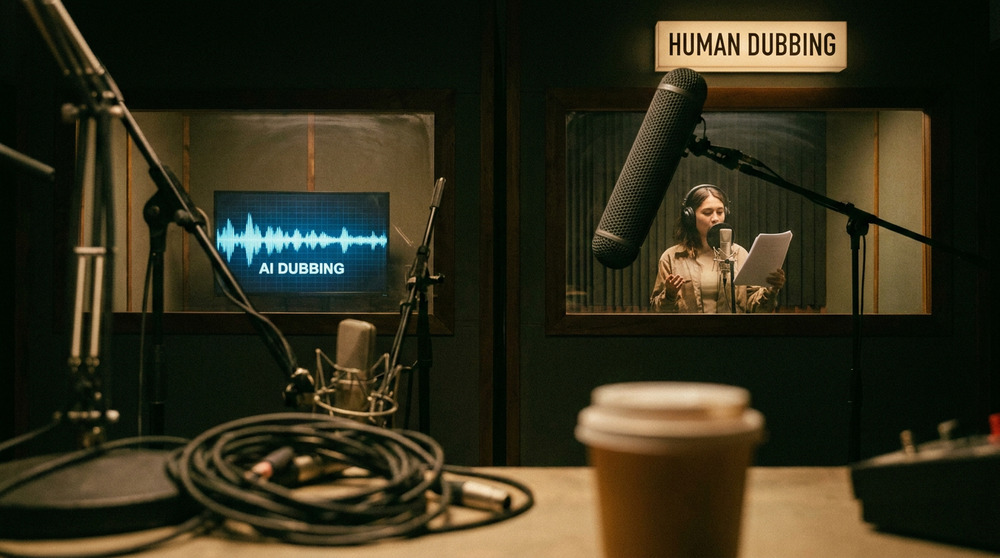
AI Dubbing vs Human Dubbing: What Do Viewers Prefer?
AI dubbing and human dubbing are both powerful approaches that enable content creators to deliver their productions in various languages worldwide. However, there is no single rule determining which form of voice dubbing viewers prefer. The advantage of AI dubbing lies in speed, scalability, and increasingly realistic voice naturalness. On the other hand, human dubbing remains essential for conveying complex emotion, cultural nuances, and character continuity.
The deciding factor between the two depends primarily on the content format, emotional depth, and how heavily localization impacts the overall viewing experience.
What Is AI Dubbing vs Human Dubbing?
 AI dubbing vs Human dubbing refers to two approaches to adapting spoken content into another language.
AI dubbing uses artificial intelligence engines to perform tasks such as transcribing, translating, generating synthetic audio, and synchronizing dialogue with visuals. By contrast, human dubbing is a collaborative process involving translators, voice actors, dubbing directors, and localization specialists.
Dubbing powered by artificial intelligence is gaining rapid adoption. For instance, YouTube currently supports auto-dubbing in 27 languages and reported that over 6 million viewers spent at least 10 minutes per day watching auto-dubbed content in December 2025 alone.
One reason why human dubbing is often preferred is the level of control one can have over the cultural context, feelings, and speaking qualities of the voices. A paper was published in Transactions of the Association for Computational Linguistics in 2023 that evaluated 319.57 hours of 54 professionally dubbed movies and emphasized both the significance of accurate translation and the necessity of natural speech delivery.
Also read: What Southeast Asian Audiences Expect from Localized Short Drama Content
Benefits of AI Dubbing vs Human Dubbing
There is no single winner across all viewing situations. Each approach offers different benefits.
Benefits of AI Dubbing
AI dubbing is particularly useful when content needs to be localized quickly or across many languages.
- Faster production: AI can automate several time-consuming steps in the dubbing workflow.
- Greater scalability: A single piece of content can potentially be prepared for multiple markets without arranging a completely separate production workflow for every language.
- Lower production barriers: AI can make multilingual audio more accessible to smaller creators and businesses.
- Consistent processing: Automated workflows can apply standardized terminology and production settings across large content libraries.
- Rapid experimentation: Publishers can test localized versions of content without committing immediately to a full traditional dubbing production.
Benefits of Human Dubbing
Human dubbing remains particularly important when performance and cultural context are central to the content.
- Emotional accuracy: Human actors can respond to subtle changes in emotion, tension, humor, and character relationships.
- Cultural adaptation: Translators can adapt idioms, jokes, references, and forms of address based on local context.
- Character consistency: Voice actors can establish a recognizable performance across episodes or seasons.
- Creative direction: Directors can adjust delivery based on the scene rather than relying entirely on automated interpretation.
- Quality control: Linguists and production teams can identify errors before the localized version reaches viewers.
So, the more useful question is not simply, "Do viewers prefer AI or humans?" It is, "What level of dubbing quality do viewers expect for this type of content?"
For an informational video, AI dubbing may be perfectly acceptable when the main requirement is fast access to understandable information. For a drama with emotionally complex performances, audiences may be more sensitive to unnatural delivery or inaccurate cultural adaptation.
In other words, viewer preference can be content-dependent rather than technology-dependent.
Also read: One Voice, Many Characters: The Role of Voice Actors in Localized Content
How AI and Human Dubbing Compare
AI and human dubbing differ mainly in accuracy, voice performance, cultural adaptation, and production speed.
1. Translation Accuracy
AI can translate large volumes quickly but may struggle with context, idioms, slang, and specialized terms. Human linguists can refine meaning, terminology, and cultural context. A hybrid workflow can combine AI speed with human review.
2. Voice Naturalness
AI voices continue to improve in pitch, rhythm, and tone. However, human actors can adjust timing, emphasis, reactions, and delivery based on the scene and character.
3. Emotional Performance
Human dubbing remains valuable for complex emotions such as sarcasm, fear, romance, or subtle dramatic reactions. AI is improving in expressive speech but may require human direction for nuanced performances.
4. Cultural Localization
Translation alone does not guarantee effective localization. Human specialists can adapt jokes, idioms, social references, and forms of address to suit the target audience.
5. Speed and Scale
AI dubbing can process large volumes of content quickly, making it useful for educational videos, tutorials, social media, short-form content, and large video libraries. Human dubbing may be preferred for productions where performance and cultural nuance require greater attention.
How the Dubbing Process Works
Whether using AI, human dubbing, or a hybrid model, the process typically includes:
- Analyze the content: Review dialogue, tone, characters, terminology, and cultural references.
- Transcribe and translate: Convert the original dialogue into a target-language script.
- Adapt the script: Adjust wording for natural speech, timing, and character personality.
- Generate or record voices: Use AI-generated voices or professional voice actors.
- Synchronize audio: Match the dubbed dialogue with the original video's timing.
- Perform quality assurance: Check translation, pronunciation, terminology, timing, cultural accuracy, and audio quality.
Common Mistakes or Challenges
Assuming AI Dubbing Is Automatically Cheaper
AI can reduce production time and operational costs, but the total cost depends on the technology, language coverage, voice requirements, human review, editing, and quality assurance.
A low-cost automated output may require significant correction if the initial translation or voice generation is poor.
Assuming Human Dubbing Is Always Better
Human dubbing can provide strong creative and linguistic control, but quality still depends on the translators, actors, directors, and production team.
Human involvement does not automatically guarantee a good localized version.
Using the Same Workflow for Every Type of Content
A product tutorial, documentary, comedy series, and romantic drama have different localization requirements.
An AI-first workflow may be suitable for some content but inadequate for others.
Ignoring Target-language Differences
AI dubbing can process multiple languages at scale, but each language has its own pronunciation, sentence structure, cultural references, and conversational conventions.
A workflow that works well for English-to-Indonesian dubbing may not produce the same results for another language pair.
Focusing on Voice Quality While Ignoring Translation
A highly realistic synthetic voice cannot compensate for an inaccurate translation.
Viewers may forgive a slightly artificial voice more easily than dialogue that changes the meaning of a scene.
Failing to Give Viewers A Choice
As multilingual viewing becomes more common, giving audiences control can be useful.
YouTube allows viewers to switch between available audio tracks and set preferred language options. This approach recognizes that even viewers who understand the target language may sometimes prefer the original performance.
Also read: How Indonesian Dubbing Services Support Global Expansion
FAQ
Is AI dubbing better than human dubbing?
Neither is universally better. AI dubbing is useful for speed, scale, and high-volume localization, while human dubbing provides greater control over performance, cultural nuance, and character interpretation.
Do viewers prefer AI dubbing or human dubbing?
There is no universal viewer preference established by current evidence. Audience response depends on content type, language, audio quality, emotional complexity, and individual viewing preferences.
What are the advantages of human dubbing?
Human dubbing offers professional voice performance, cultural interpretation, creative direction, and greater control over character consistency and emotional delivery.
What are the advantages of AI dubbing?
AI dubbing can accelerate production, support large numbers of languages, and make multilingual audio more accessible for creators and businesses with large content libraries.
Can AI and human dubbing be used together?
Yes. A hybrid workflow can use AI for transcription, translation assistance, voice generation, or timing while human linguists and localization professionals review and refine the output.
Will AI replace human dubbing?
AI is likely to change how dubbing is produced, but current workflows still benefit from human expertise for translation review, cultural adaptation, voice direction, and quality assurance. The future is more likely to involve different combinations of AI and human work depending on the content.
Conclusion
The AI dubbing vs Human dubbing debate is becoming less about choosing one technology and more about understanding what viewers expect from localized content. AI dubbing offers speed, scalability, and increasingly natural speech, while human dubbing continues to provide important advantages in emotional performance, cultural adaptation, and creative quality control.
Professional localization services can also help businesses determine where human expertise adds the most value, from script adaptation and terminology review to voice casting, cultural checks, and final quality assurance. This approach allows companies to use AI efficiently without treating automation as a replacement for localization expertise.
Digital-Trans Asia provides professional translation, interpretation, and localization services for businesses across Asia.