
What Is Localization Quality Assurance (LQA)? Benefits, Process, and Best Practices
Expanding into international markets requires more than translating content into different languages. Businesses must ensure that their localized products, services, and communications are accurate, culturally appropriate, and consistent with local expectations. This is where Localization Quality Assurance (LQA) becomes essential.
LQA helps businesses identify linguistic errors, terminology inconsistencies, cultural issues, and other localization-related problems before they affect the end-user experience. By incorporating quality assurance into localization projects, companies can maintain brand consistency, improve customer experiences, and prepare their products for international audiences.
Whether a business is localizing a website, mobile application, video game, or digital content, understanding LQA is an important part of building a reliable global expansion strategy.
What Is Localization Quality Assurance (LQA)?
Localization Quality Assurance (LQA) is the process of evaluating localized content and products to ensure they meet the linguistic, cultural, and quality requirements of their intended markets.
The term LQA is commonly used in the localization industry to describe linguistic quality evaluation. In broader localization projects, it can also refer to quality checks that consider the overall localized experience, including visual presentation and functional behavior.
For example, a mobile game translated from English into Indonesian may contain grammatically correct dialogue but still have inconsistent character names, unnatural expressions, or text that does not fit within the user interface. LQA helps identify these issues before the localized version reaches players.
Localization Quality Assurance generally covers several important areas:
- Linguistic accuracy: Checking grammar, spelling, punctuation, translation accuracy, and terminology consistency.
- Cultural relevance: Ensuring that localized content reflects the cultural expectations and communication styles of the target audience.
- Contextual accuracy: Verifying that translated messages retain their intended meaning within the product or content.
- Visual consistency: Reviewing text display, formatting, and layout in the localized version.
- Functional quality: Checking relevant localized interface elements and product features to identify issues that could affect usability.
These areas help businesses ensure that localized content does more than communicate the same words. It should also deliver the intended meaning and experience to users in each target market.
Why Is LQA Important for Businesses?
Localization quality can influence how international customers perceive a brand, understand its products, and interact with its services. Poorly localized content may create confusion, reduce trust, and affect the overall customer experience.
Here are five reasons why businesses should consider LQA as part of their localization strategy.
1. Maintains Brand Consistency Across Markets
Businesses need consistent messaging when communicating with customers in different countries. Inconsistent terminology, incorrect product descriptions, and variations in brand tone can make a company appear less professional.
LQA helps maintain consistent terminology, messaging, and brand identity across localized content. This is particularly important for companies managing multiple languages, products, and communication channels.
2. Improves Customer Experience
Customers expect localized content to feel natural and easy to understand. Direct translations that ignore cultural context or local language conventions may create confusing or unnatural experiences.
By reviewing linguistic accuracy and contextual relevance, LQA helps businesses deliver content that better reflects how their target audiences communicate and interact with products.
3. Reduces Localization Errors and Rework
Localization problems discovered after publication or product release may require additional translation, editing, development, and testing.
LQA helps identify potential issues earlier, allowing businesses to address them before they affect customers. This can reduce avoidable corrections and support more efficient localization workflows.
4. Supports Better Product Quality
For digital products such as mobile applications, software, and video games, language quality is closely connected to usability.
Incorrect instructions, inconsistent interface terminology, or poorly adapted dialogue can affect how users understand and navigate a product.
LQA helps businesses maintain a consistent experience across different language versions while supporting the quality of their localized products.
5. Strengthens International Market Readiness
Entering a new market requires an understanding of local language conventions, cultural expectations, and customer preferences.
LQA helps businesses verify whether their localized content is suitable for its intended audience before launch. This supports a more reliable approach to introducing products and services across international markets.
What Are the Main Areas of Localization Quality Assurance?
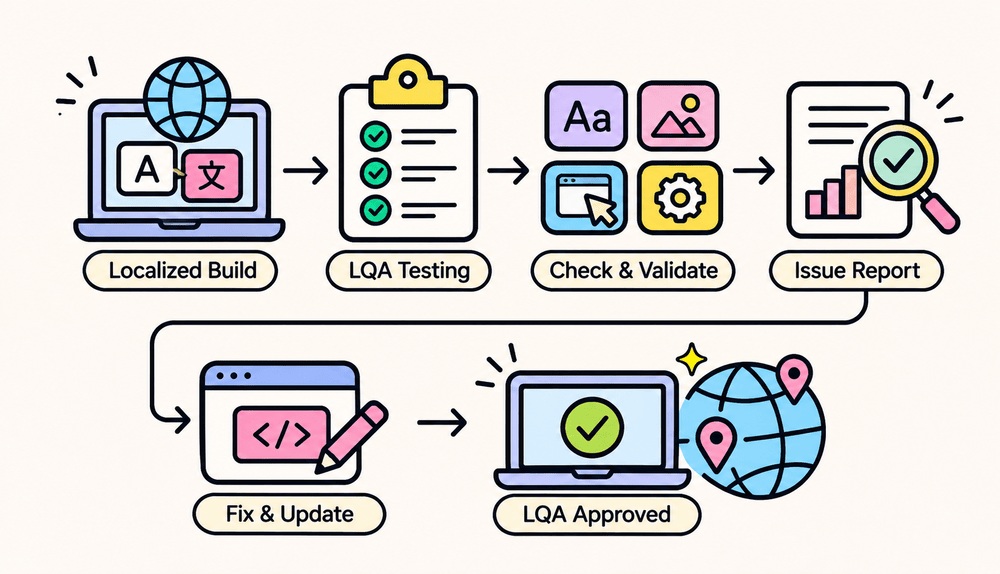
The scope of LQA depends on the content, product, and requirements of each localization project. However, several quality areas are commonly considered.
1. Linguistic Quality Assurance
Linguistic QA focuses on the accuracy and consistency of translated content.
Typical evaluation criteria include:
- Grammar, spelling, and punctuation.
- Translation accuracy and completeness.
- Terminology and glossary consistency.
- Brand voice and writing style.
- Natural language flow and readability.
- Consistency across different content sections.
For example, a software company may use different translations for the same feature across its user interface, product descriptions, and help documentation. Linguistic QA helps identify these inconsistencies and maintain a unified terminology standard.
2. Cultural and Contextual Quality
Cultural quality assurance checks whether localized content is appropriate for the target market.
This may include reviewing:
- Idioms and expressions.
- Cultural references and humor.
- Images, symbols, and visual references.
- Local communication conventions.
- Region-specific terminology.
- Sensitive or potentially misleading content.
A marketing message that works in one country may not have the same meaning or impact in another. Cultural review helps businesses avoid misunderstandings and make their communications more relevant to local audiences.
3. Visual and User Interface Quality
Visual quality checks examine how translated content appears within the actual product or interface.
Common issues include:
- Text overflowing its designated space.
- Incorrect font rendering.
- Inconsistent spacing and alignment.
- Missing or untranslated interface elements.
- Formatting problems caused by text expansion.
- Incorrect date, time, and currency displays.
These checks are especially relevant to software, mobile applications, games, and other products with multilingual interfaces.
4. Functional Localization Quality
Functional quality checks help verify that relevant localized features operate as expected.
Depending on the project, this may involve reviewing:
- Navigation and menu elements.
- Language selection features.
- Localized forms and input fields.
- Regional settings and formatting.
- Error messages and notifications.
- Localized user instructions.
The objective is to ensure that localization does not introduce problems that interfere with the intended user experience.
How Does LQA Fit Into the Localization Process?
LQA should be integrated into the broader localization workflow rather than treated as an optional final review.
Although the exact workflow varies by project, a typical localization quality assurance cycle includes:
- Establish quality requirements: Define target languages, terminology guidelines, reference materials, and project-specific quality expectations.
- Review localized content: Evaluate translations for accuracy, completeness, consistency, and contextual relevance.
- Check localized presentation: Review the content in its intended format or product environment to identify visual and contextual issues.
- Document quality issues: Record identified errors and provide clear recommendations for correction.
- Validate corrections: Review updated content to confirm that reported issues have been addressed.
For complex software, game, or application projects, additional functional testing may be required.
A structured approach helps localization teams maintain consistent quality across languages and deliverables.
What Is the Difference Between LQA and Translation QA?
LQA and Translation Quality Assurance are closely related, but their scope may differ depending on how the terms are used.
Translation QA primarily focuses on the linguistic quality of translated text. Broader localization QA may also consider cultural suitability, visual presentation, and functional behavior.
| Evaluation Area | Translation QA | Broader Localization QA |
|---|---|---|
| Grammar and spelling | Yes | Yes |
| Translation accuracy | Yes | Yes |
| Terminology consistency | Yes | Yes |
| Cultural relevance | Depending on scope | Yes |
| Contextual accuracy | Yes | Yes |
| Visual presentation | Usually excluded | Yes |
| UI and functional checks | Usually excluded | Yes |
| Regional formatting | Depending on scope | Yes |
Businesses should establish the scope of quality assurance before starting a project to ensure that the evaluation covers the requirements of each target market.
When Should Businesses Invest in LQA?
LQA is valuable whenever businesses need to deliver localized content or digital products to audiences in different languages and regions.
Some common applications include:
- Website localization: Reviewing translated website content, navigation, and localized user-facing information.
- Mobile application localization: Checking interface terminology, translated instructions, and localized user experiences.
- Software localization: Maintaining language consistency across product interfaces, documentation, and software features.
- Game localization: Reviewing in-game dialogue, subtitles, menus, character names, and other player-facing content.
- Video and subtitle localization: Ensuring translated subtitles are accurate, readable, and appropriate for the context.
- Marketing localization: Checking campaign messaging, promotional materials, and brand communication across markets.
For businesses managing multiple languages or frequent content updates, incorporating LQA into the regular localization workflow can help maintain quality over time.
Best Practices for Effective Localization Quality Assurance
Businesses can improve localization quality by establishing clear standards and maintaining consistent review practices.
Consider these best practices:
- Create a terminology glossary: Maintain approved translations for product names, technical terms, and frequently used expressions.
- Develop language style guides: Define tone of voice, writing conventions, and market-specific language preferences.
- Use qualified native-language reviewers: Work with linguists who understand the target language and regional context.
- Provide sufficient context: Share screenshots, reference materials, and product information to help reviewers understand how translated content will be used.
- Apply consistent quality criteria: Establish clear evaluation standards across different languages and projects.
- Maintain feedback and correction records: Document recurring issues to improve future localization work.
- Review content after updates: Recheck affected localized content whenever the original product or source text changes.
These practices help businesses create a more consistent approach to localization quality and reduce the likelihood of recurring errors.
Frequently Asked Questions (FAQ)
What does LQA stand for?
LQA commonly stands for Linguistic Quality Assurance in the translation industry. In broader localization projects, it may also refer to Localization Quality Assurance, covering additional aspects of localized content and product quality.
What is the main purpose of Localization Quality Assurance?
The main purpose of LQA is to identify and address quality issues in localized content before they affect the intended audience. It helps maintain translation accuracy, terminology consistency, cultural relevance, and a reliable user experience.
What are the main types of LQA?
LQA can include linguistic evaluation, cultural and contextual review, visual quality checks, and functional localization testing. The exact scope depends on the product and project requirements.
Is LQA different from proofreading?
Yes. Proofreading generally focuses on correcting spelling, grammar, punctuation, and other writing errors. LQA can cover a broader range of localization requirements, including translation accuracy, terminology, cultural context, and product-specific quality checks.
Is LQA necessary for video games and mobile applications?
LQA is particularly valuable for games and mobile applications because localized content is closely connected to the user experience. It helps identify inconsistent terminology, unnatural dialogue, display issues, and other problems that may affect users.
When should LQA be performed?
LQA should be incorporated into the localization workflow and completed before localized content or products are released. Additional reviews may also be necessary after updates, new translations, or significant product changes.
Can AI translation tools replace LQA?
AI translation tools can support translation workflows, but their output still requires appropriate quality evaluation. Human linguistic and contextual review remains important for identifying nuanced errors, cultural issues, and terminology problems that automated systems may overlook.
Conclusion
Localization Quality Assurance is an important part of delivering accurate, consistent, and culturally appropriate content to international audiences. By evaluating linguistic quality, cultural relevance, visual presentation, and relevant product functionality, businesses can identify localization issues before they affect customers.
For companies planning international expansion, LQA should be considered an integral part of their localization strategy rather than simply a final proofreading step.
Whether you are localizing a video game, mobile application, website, or multimedia content, maintaining quality across languages can help create more reliable experiences for your global audience.
Planning to localize your content for international markets?
Digital Trans Asia provides localization solutions for businesses looking to connect with audiences across Southeast Asia. Our services include game localization and subtitle localization, with LQA and proofreading as part of our quality-focused workflow.
Contact Digital Trans Asia to discuss your localization requirements and explore how our team can support your multilingual content projects.
Also explore our services: