
What Is Culturalization and Why Is It Important for Game Publishers?
The adaptation of game content, game symbolism, story lines, graphics, and gameplay aspects to correspond to cultural values, historical realities, and legal requirements of certain countries' markets is called culturalization. In contrast with translation, culturalization makes sure that the adapted video game meets the expectations of its audience and corresponds to their cultural peculiarities.
What is Culturalization?

Speaking about what culturalization is, you should not confuse this concept with localization.
Localization implies adjusting language, currencies, dates, units of measurement, as well as a user interface to the needs of the target market. Culturalization takes things to the next level because it considers how suitable the content of the game is for its target audience.
So, a game might be fully translated into the language spoken in Japan or Arabic-speaking countries, but if the content turns out to be unsuitable for a particular culture or even offensive, the game won't attract potential players.
Culturalization may include the following adjustments:
- Storylines and dialogue
- Character names
- Clothing and character design
- Colors and symbols
- Gestures and body language
- Religious references
- Historical events
- Maps and borders
- Holidays and celebrations
- Marketing materials
Game publishers increasingly recognize that successful international launches depend on more than accurate translation. According to CSA Research, approximately 76% of online consumers prefer purchasing products with information in their own language, demonstrating that localized experiences significantly influence user engagement.
While this statistic focuses on language, it also highlights the broader importance of creating experiences that feel natural to local audiences.
Culturalization vs Localization
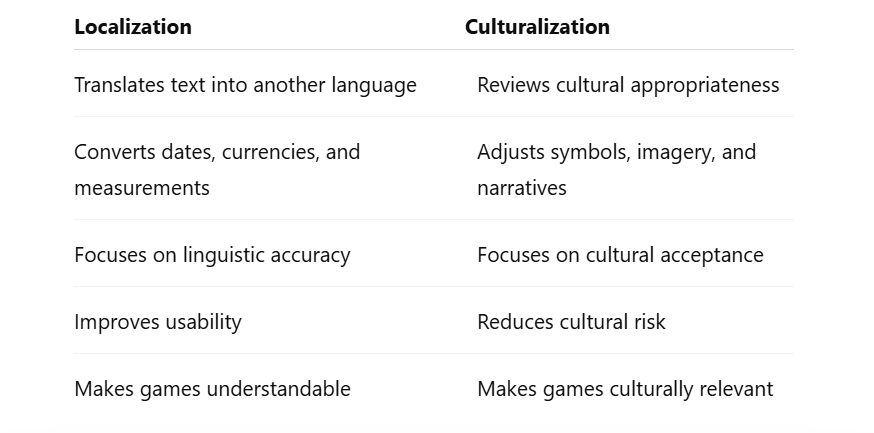
Although the terms are sometimes used interchangeably, they represent different stages of preparing content for international audiences.
The most successful global games combine both localization and culturalization as part of a comprehensive internationalization strategy.
Also read: What Are the Most Common Cultural Challenges in Game Localization
Why Culturalization Matters More Than Ever
The global video game industry has become one of the world's largest entertainment sectors. According to Statista, global gaming revenue continues to exceed $180 billion annually, with Asia-Pacific representing the largest regional market.
This means publishers are no longer designing games for a single country. A title released on PC, console, or mobile may immediately reach players across dozens of markets with very different cultural expectations.
A cultural issue that seems minor in one country can quickly become a major public relations problem elsewhere.
Examples include:
- Incorrect historical representations
- Offensive religious imagery
- Politically sensitive territorial maps
- Stereotypical character portrayals
- Inappropriate use of national symbols
- Dialogue containing culturally insensitive jokes
In some cases, games have faced public criticism, delayed launches, content removal, or regulatory rejection because cultural considerations were overlooked during development.
Benefits / Use Cases
Investing in culturalization provides advantages beyond avoiding controversy.
Builds Player Trust
Players appreciate games that demonstrate an understanding of their culture rather than simply translating text.
A culturally adapted experience feels more authentic, increasing player satisfaction and long-term engagement.
Reduces Business Risk
Cultural review helps identify potential issues before launch.
This can prevent:
- Negative media coverage
- Social media backlash
- Store removal
- Government restrictions
- Costly post-release updates
Identifying issues before launch helps avoid the higher costs associated with post-release fixes.
Supports Global Market Expansion
Each market has unique cultural expectations.
For example:
- Colors associated with celebration in one country may symbolize mourning in another.
- Animal symbolism varies widely.
- Certain hand gestures are acceptable in some cultures but offensive in others.
Culturalization helps publishers confidently enter new regions with fewer unexpected challenges.
Improves Brand Reputation
Respectful localization demonstrates that publishers value their international communities.
Over time, this strengthens brand credibility and player loyalty.
Creates More Immersive Experiences
Players become more emotionally connected when dialogue, humor, traditions, and cultural references feel natural rather than forced.
This can improve user reviews and overall retention.
Also read: Multimodal Localization in Comics: How Language Services Support Global Publishing
How It Works / Process
A structured culturalization process usually involves multiple specialists working together throughout development.
Step 1: Analyze the Target Market
The first step is understanding the cultural, historical, legal, and social landscape of the target region.
This includes researching:
- Religious sensitivities
- Political issues
- Local regulations
- Cultural norms
- Popular entertainment trends
- Player expectations
Step 2: Review Game Content
Experts examine every element of the game, including:
- Dialogue
- Storylines
- Artwork
- Music
- User interface
- Marketing assets
- Character design
- World maps
The objective is to identify anything that could confuse or offend local audiences.
Step 3: Assess Potential Risks
Each identified issue is evaluated based on:
- Cultural sensitivity
- Legal compliance
- Brand impact
- Audience perception
- Likelihood of controversy
Not every cultural difference requires modification.
The goal is to distinguish genuine risks from harmless differences.
Step 4: Recommend Appropriate Changes
Recommendations should preserve the original creative vision whenever possible.
Possible adjustments include:
- Rewriting dialogue
- Changing artwork
- Modifying symbols
- Replacing references
- Updating character names
- Revising promotional materials
Step 5: Validate With Native Experts
Native linguists and cultural consultants review the final content before launch.
Their feedback helps ensure the adapted version feels natural rather than artificially localized.
Also read: How Real-Time Localization Supports Fast-Paced Comic Publishing
Common Examples of Culturalization in Games
Different regions often require different types of cultural adaptation.
Religious Symbols
Symbols that are considered decorative in one country may have sacred meanings elsewhere.
Improper use can generate significant public criticism.
Historical References
Games featuring real historical events should consider regional interpretations.
History is often viewed differently across countries, especially when conflicts or national identity are involved.
Character Design
Character clothing, hairstyles, tattoos, and accessories may carry unexpected cultural meanings.
Small visual adjustments can improve acceptance without changing gameplay.
Maps and Geography
International releases often require careful handling of territorial boundaries and disputed regions.
These issues frequently involve both legal compliance and political sensitivity.
Humor
Humor rarely translates directly across cultures.
Wordplay, sarcasm, cultural references, and idioms often require creative adaptation instead of literal translation.
Common Mistakes / Risks
Even experienced development teams can overlook cultural considerations.
Treating Translation as Culturalization
Accurate translation does not guarantee cultural appropriateness.
Language specialists may not always evaluate historical or cultural context unless specifically requested.
Best practice: Include cultural review alongside localization rather than after translation is complete.
Waiting Until Development Is Finished
Late-stage changes are expensive and may delay release schedules.
Best practice: Integrate culturalization into early development and content review.
Assuming One Version Fits Every Market
International audiences are not culturally identical.
A design choice accepted in North America may require changes for East Asia, the Middle East, or Europe.
Best practice: Evaluate each major target market individually.
Ignoring Local Regulations
Some countries have specific regulations covering violence, gambling mechanics, political content, religious imagery, or depictions of human remains.
Best practice: Review legal requirements alongside cultural expectations before release.
Using Stereotypes
Oversimplified portrayals of cultures may damage player trust even when they are not intentionally offensive.
Best practice: Work with native reviewers who understand contemporary cultural perspectives.
FAQ
1. What is culturalization?
Culturalization is the process of adapting content to align with the cultural values, beliefs, traditions, regulations, and expectations of a specific audience while preserving the creator's intended experience.
2. Is culturalization the same as localization?
No. Localization primarily focuses on language and regional formats, while culturalization evaluates whether the content itself is culturally appropriate and relevant.
3. Why is culturalization important for game publishers?
It helps publishers reduce cultural risks, improve player experience, protect brand reputation, and support successful international launches.
4. Does every game need culturalization?
Games released in multiple countries generally benefit from culturalization, especially those featuring historical, religious, political, or culturally specific content.
5. When should culturalization begin?
Ideally, culturalization should begin during game development rather than after translation is completed. Early planning reduces costs and minimizes launch delays.
6. Who performs culturalization?
Professional localization teams often collaborate with native linguists, cultural consultants, regional reviewers, legal experts, and game publishers.
7. Can culturalization affect gameplay?
Sometimes. Most changes involve dialogue, artwork, symbols, or presentation, but gameplay mechanics may also require adjustment if they conflict with local regulations or cultural expectations.
8. Does culturalization change the original story?
Not necessarily. The objective is to preserve the creative vision while adapting elements that may create unnecessary cultural barriers or misunderstandings.
9. How does culturalization improve player experience?
Players are more likely to enjoy games that feel natural, respectful, and relevant to their own culture, resulting in stronger engagement and positive community feedback.
How Professional Localization Supports Culturalization
Successful culturalization requires more than linguistic expertise. It also depends on understanding regional history, cultural expectations, legal requirements, and player behavior.
Working with experienced localization professionals allows game publishers to identify potential issues early, adapt content thoughtfully, and maintain consistency across multiple markets while preserving the original creative intent.
Digital Trans Asia provides professional translation, interpretation, and localization services for businesses across Asia.
Conclusion
Having a clear understanding of culturalization is essential for any game publisher planning to reach international audiences. While localization ensures players can understand a game, culturalization ensures they can genuinely connect with it. By adapting content to respect local cultures, publishers can reduce business risks, strengthen player trust, and deliver more engaging experiences across global markets.
Ready to localize and culturalize your game for Asian markets? Visit https://digital-trans.asia/ to learn more about our services. Contact us today to get started!