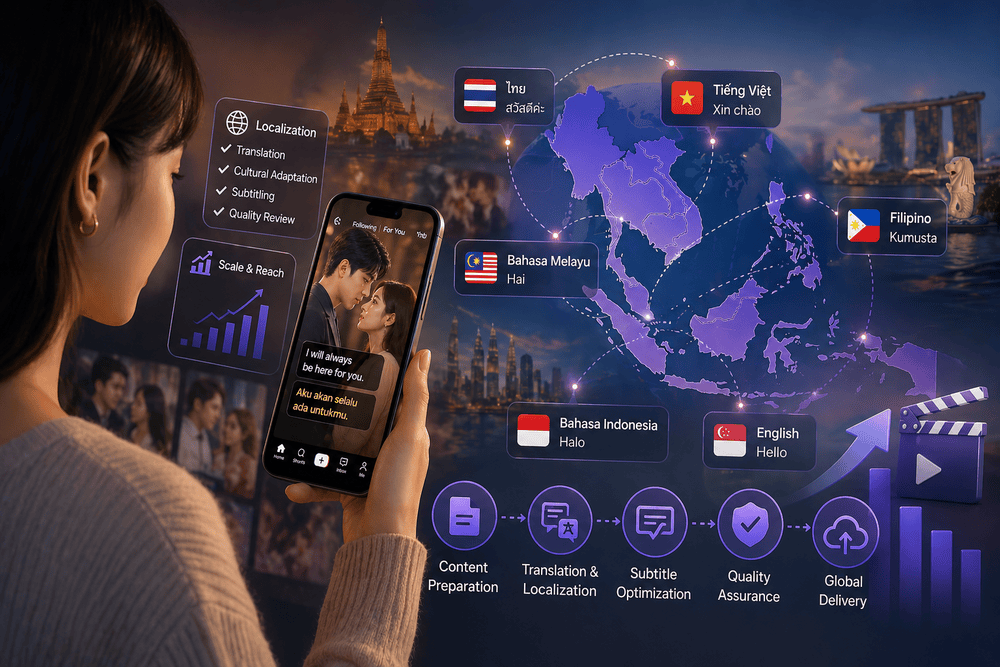
How to Expand Short Drama Content to Southeast Asian Markets Through Localization
Expanding short drama content to Southeast Asian markets through localization means adapting your content — linguistically, culturally, and technically — so that audiences in Indonesia, Thailand, Vietnam, the Philippines, Malaysia, and beyond can consume it as naturally as audiences in the source market. For content platforms, streaming companies, and short drama producers, this is the most direct route to audience growth in one of the world's fastest-expanding digital entertainment regions.
Southeast Asia is home to over 675 million people across diverse language groups, with mobile internet penetration accelerating rapidly across every major market. Short drama content—particularly formats originating from China and Korea—is gaining significant traction across the region, driven by mobile-first consumption habits and an appetite for episodic, fast-paced storytelling. However, content that is not localized into the target language consistently underperforms against localized alternatives in both engagement and retention metrics.
Localization is not simply translation. It is the full process of making content feel native to a new market—from subtitle accuracy and cultural adaptation to platform formatting and release timing. This guide outlines the strategic and operational steps for content businesses looking to enter or scale across Southeast Asian markets through professional localization.
What It Means to Localize Short Drama Content for Southeast Asia
Localizing short drama content for Southeast Asian markets refers to the process of adapting video content — including subtitles, dubbing, on-screen text, and cultural references — into the languages and cultural contexts of specific target markets within the region.
Southeast Asia is not a single market. It is a collection of distinct language ecosystems, each with its own formality registers, humor conventions, cultural sensitivities, and audience expectations. Effective localization treats each market individually rather than applying a regional blanket approach.
Key languages for short drama localization in Southeast Asia include Bahasa Indonesia, Thai, Vietnamese, Filipino (Tagalog), Malay, and Burmese—each requiring dedicated translation, cultural review, and platform-specific formatting to meet audience expectations and perform competitively on streaming platforms.
Business Impact of Localizing Short Drama Content for Southeast Asian Markets
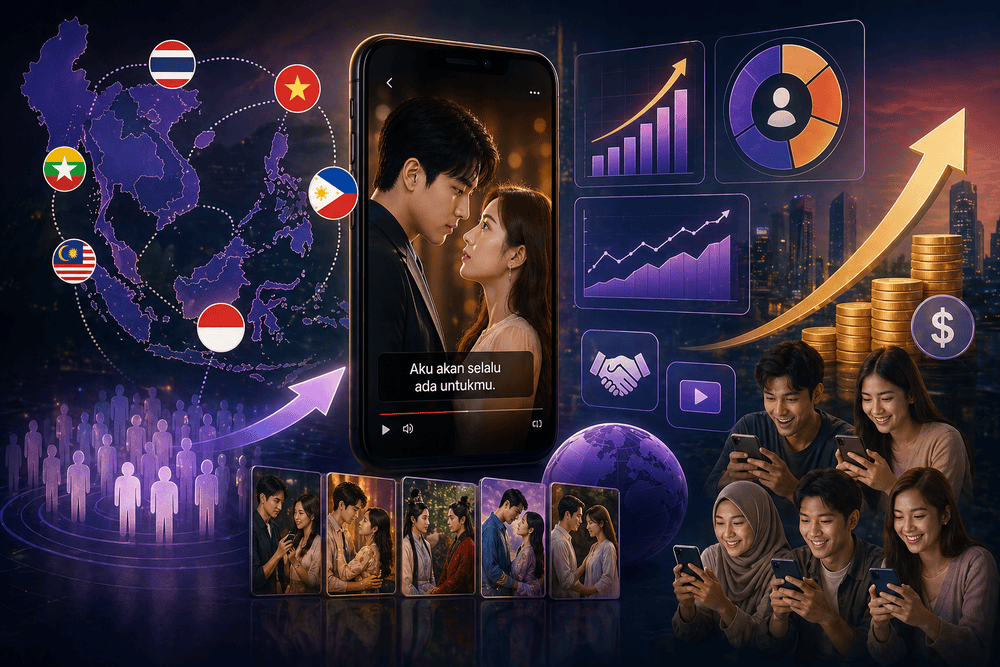
Content platforms and producers that invest in professional localization for Southeast Asian markets gain measurable advantages across the metrics that matter most to business growth.
-
Expanded total addressable audience — Localized content reaches viewers who will not engage with unsubtitled or machine-translated content, directly increasing the platform's addressable user base in each target market.
-
Higher viewer retention and episode completion rates — Audiences who can follow content in their native language watch more episodes per session and return more frequently, improving the engagement data that drives algorithmic recommendation and platform growth.
-
Faster market penetration — Professionally localized content competes immediately with locally produced content, reducing the time required to build audience share in a new market.
-
Increased content licensing and distribution value — Localized content is significantly more attractive to local distribution partners, OTT platforms, and network buyers across the region, increasing the commercial value of the content library.
-
Stronger brand positioning in competitive markets—Platforms that invest in high-quality local language content signal long-term commitment to the market, building audience trust and brand affinity that sustains growth beyond initial launch.
-
Revenue from high-growth mobile-first markets—Indonesia, Vietnam, and the Philippines represent some of the fastest-growing mobile streaming markets globally, with large young demographics actively seeking short-form content in their native languages.
How to Expand Short Drama Content to Southeast Asian Markets: A Step-by-Step Process
1. Conduct Market Prioritization Before Localization Begins
Not every Southeast Asian market carries equal commercial opportunity for every content type. Analyze existing platform data, audience demographics, content consumption trends, and the competitive landscape in each target market. Prioritize markets where demand for your content category is growing and where localized supply is currently limited.
2. Identify the Right Localization Format for Each Market
Different markets respond differently to subtitle-based versus dubbing-based localization. In general, Indonesian and Filipino audiences are comfortable with subtitles and consume localized content at high volume. Thai audiences have historically preferred dubbed content for certain formats. Conduct market-specific research or work with a localization partner familiar with regional preferences before committing to a single format across all markets.
3. Develop a Series-Level Localization Brief
Before production begins, create a comprehensive localization brief for each series. This should include character name conventions, show-specific terminology, tonal guidelines, cultural references that require adaptation, and any content elements that may require adjustment for local regulatory or cultural standards. A well-prepared brief prevents costly revisions and ensures consistency across episodes and language versions.
4. Build or Source Language-Specific Localization Capacity
Each target language in Southeast Asia requires qualified translators, cultural reviewers, and editors with native-level fluency and familiarity with the short drama format. Attempting to localize across multiple SEA languages using generalist translation resources or machine translation without human review consistently produces output that fails to meet audience quality expectations.
5. Implement Translation Memory and Terminology Management
For episodic content released at volume, translation memory systems and controlled terminology glossaries are essential for maintaining consistency across episodes, reducing per-episode cost as the series scales, and accelerating turnaround without sacrificing quality. These systems become more valuable as content volume increases.
6. Apply Cultural Adaptation at the Review Stage
Cultural adaptation review is a distinct step from linguistic translation. A native-language reviewer should assess each localized version for cultural accuracy, tonal appropriateness, idiomatic naturalness, and potential sensitivities specific to that market. This step is what separates localization that retains viewers from translation that alienates them.
7. Format Content to Platform Technical Requirements
Each distribution platform in Southeast Asia has specific technical requirements for subtitle files, dubbing synchronization, audio specs, and metadata. Localized content that does not meet platform technical standards will be rejected or display incorrectly, undermining the investment made in linguistic quality. Technical formatting must be treated as a mandatory step, not an afterthought.
8. Plan for Simultaneous Multi-Market Release
Releasing localized content simultaneously across multiple markets — rather than sequentially — maximizes the commercial impact of the localization investment, prevents content from being pirated with lower-quality unofficial subtitles, and strengthens the platform's competitive position against local content. A scalable localization workflow makes simultaneous release operationally achievable.
Common Mistakes When Expanding Short Drama Content to Southeast Asian Markets
Treating Southeast Asia as a single market. Applying one localization strategy, one language, or one cultural brief across the entire region consistently underperforms. Indonesian audiences have different expectations from Thai audiences, and Vietnamese audiences have different expectations from Filipino audiences. Market-specific localization always outperforms regional generalization.
Relying on machine translation without human cultural review. Machine translation tools have improved significantly but remain inadequate for short drama content, where emotional register, humor, romantic tension, and culturally specific dialogue are central to audience engagement. Unreviewed machine translation damages audience trust and platform credibility.
Delaying localization to a post-production phase. Localization that begins after content finalization faces tighter timelines, higher revision costs, and greater risk of quality compromise. Integrating localization planning into the content production process reduces cost, improves quality, and enables earlier market entry.
Skipping platform-specific technical requirements. Each OTT platform and distribution channel in Southeast Asia has its own technical specifications. Content that does not meet these requirements at submission creates delays and additional costs that could have been avoided with proper preparation.
Underinvesting in cultural adaptation for market-sensitive content. Short drama content frequently deals with relationship dynamics, family structures, social hierarchies, and humor that carry strong cultural specificity. Content that is linguistically translated but culturally misaligned consistently generates lower audience engagement and higher drop-off rates than content that has been properly adapted.
FAQ
What languages should be prioritized for short drama localization in Southeast Asia?
For most content platforms entering the region, Bahasa Indonesia is the highest-priority language given Indonesia's population of over 270 million and its position as one of the region's most active short drama markets. Thai, Vietnamese, and Filipino are strong second-tier priorities. Malay covers both Malaysia and Brunei. Market-specific audience data should ultimately guide prioritization decisions.
Is dubbing or subtitling more effective for short drama content in Southeast Asia?
The answer varies by market and content type. Subtitling is generally faster to produce and lower in cost and performs well in markets like Indonesia and the Philippines, where audiences are accustomed to subtitled foreign content. Dubbing delivers higher immersion and tends to perform better for younger audiences and in markets where subtitle literacy is lower. Many platforms adopt a hybrid approach—subtitling for initial market entry, adding dubbing as the content library grows and audience data supports the investment.
How long does it take to localize a short drama series for multiple Southeast Asian markets?
Turnaround time depends on episode length, language count, format (subtitles versus dubbing), and whether localization infrastructure—translation memory, glossaries, and dedicated language teams—is already in place. A single episode localized into three languages with professional subtitling typically takes three to seven business days with a prepared workflow. Building a scalable pipeline for simultaneous multi-language release requires upfront investment in process and partner relationships but significantly reduces per-episode turnaround as volume scales.
Does localization require separate regulatory approval in each Southeast Asian market?
Regulatory requirements for content distribution vary significantly across the region. Indonesia, Thailand, and Vietnam each have content regulations that may require review or modification of certain elements. A localization partner with regional expertise can advise on market-specific compliance requirements as part of the localization process.
Expanding into Southeast Asia with a Professional Localization Partner
For content platforms and short drama producers entering Southeast Asian markets, the complexity of multi-language, multi-market localization is most effectively managed through a professional localization partner with dedicated regional expertise—rather than through generalist translation vendors or internal teams without Southeast Asian language capacity.
Digital Trans Asia provides professional translation, interpretation, and localization services for businesses across Asia. With specialized capability across the major languages of Southeast Asia and direct experience in episodic content localization for streaming platforms and digital distribution, Digital Trans Asia supports content businesses in building the localization infrastructure needed to compete and grow across the region's most valuable markets.
Conclusion
Expanding short drama content to Southeast Asian markets through localization is both a strategic opportunity and an operational discipline. The platforms and producers that succeed in the region are those that approach localization not as a cost to be minimized but as a market entry investment that directly determines audience reach, viewer retention, and revenue performance. Each Southeast Asian market has distinct language, cultural, and technical requirements—and meeting those requirements with professional, culturally adapted localization is what separates content that builds lasting audiences from content that fails to gain traction. With the right localization strategy and partner infrastructure in place, simultaneous multi-market expansion across Southeast Asia is an achievable and commercially compelling growth path.
CTA
Ready to expand your short drama content across Southeast Asian markets with expert localization? Visit https://digital-trans.asia/ to learn more about our services. Contact us today to get started!