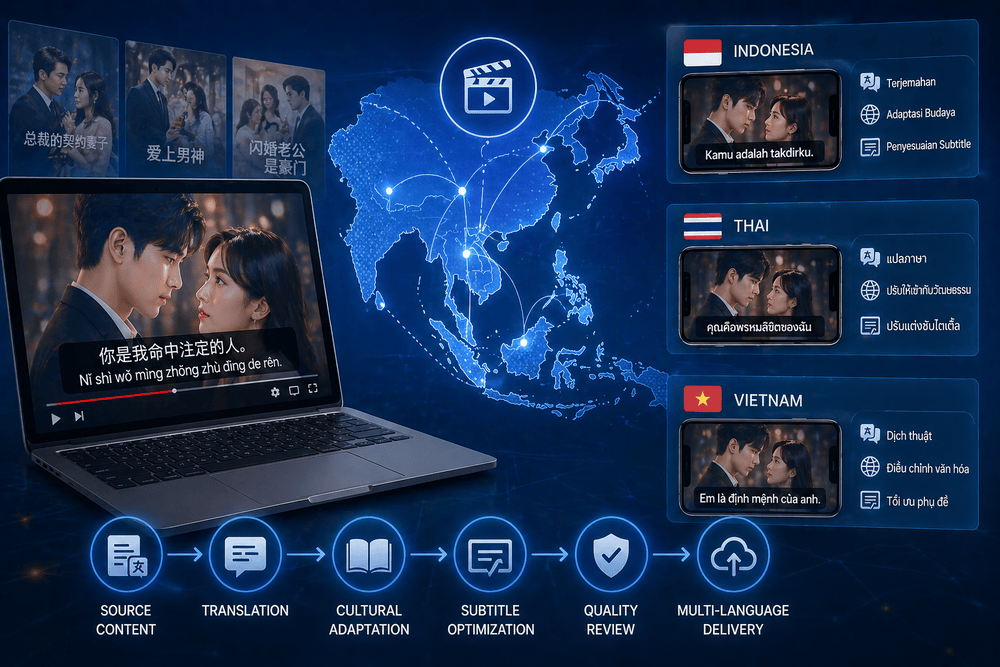
How to Localize Chinese Short Drama Series for Indonesian, Thai, and Vietnamese Audiences
Localizing Chinese short drama series for Indonesian, Thai, and Vietnamese audiences means adapting content linguistically, culturally, and technically so that viewers in each of these three distinct markets experience the drama as naturally and emotionally as audiences watching it in Mandarin. For streaming platforms, content distributors, and short drama producers targeting Southeast Asia, these three markets represent the highest-priority localization opportunities in the region based on audience size, mobile streaming growth rate, and demonstrated appetite for Chinese short drama content.
Indonesia, Thailand, and Vietnam are not interchangeable markets. Each has a distinct language structure, cultural framework, content consumption habit, and regulatory environment. A localization strategy that performs well in Indonesia may be tonally misaligned for Thai audiences, and an approach calibrated for Vietnamese viewers may not translate to the Indonesian market. Effective localization for these three markets requires dedicated, market-specific workflows, not a single regional brief applied uniformly across all three.
This guide provides a practical framework for content businesses localizing Chinese short drama series into Bahasa Indonesia, Thai, and Vietnamese, covering the strategic, linguistic, cultural, and technical requirements for each market.
What Chinese Short Drama Localization for These Three Markets Actually Involves
Localizing Chinese short drama series for Indonesian, Thai, and Vietnamese audiences is the process of converting source-language content, typically Mandarin, into subtitle or dubbed versions that are linguistically accurate, culturally appropriate, and technically formatted for distribution in each target market.
The process goes significantly beyond word-for-word translation. Chinese short drama content is heavily reliant on emotional register, relationship hierarchy language, culturally specific humor, and rapid conversational dialogue, all of which require active adaptation rather than literal conversion. Each of the three target markets has specific linguistic and cultural requirements that determine whether localized content retains viewers or loses them within the first episode.
Business Impact of Market-Specific Localization for Indonesian, Thai, and Vietnamese Audiences
Platforms and producers that invest in dedicated, market-specific localization for these three audiences unlock commercially significant growth opportunities that generalized or machine-translated content cannot access.
-
Indonesia: With over 270 million people and one of Southeast Asia's most active short drama consumption markets, Indonesia offers the largest addressable audience in the region. Professionally localized Bahasa Indonesia content consistently outperforms unlocalized or machine-translated alternatives in both organic discovery and viewer retention metrics.
-
Thailand: Thai audiences have demonstrated strong affinity for Chinese drama content, particularly romance and historical genres. Thailand's streaming market is growing rapidly, and Thai-language localization is a key differentiator for platforms competing against both local Thai content and Korean drama imports.
-
Vietnam: Vietnam represents one of the fastest-growing mobile streaming markets in Southeast Asia, with a young, digitally engaged audience actively consuming short-form content. Vietnamese-language localization opens access to a market where demand for Chinese short drama content is expanding but professional localized supply remains limited.
-
Combined market reach: Localizing a single Chinese short drama series into Bahasa Indonesia, Thai, and Vietnamese simultaneously gives platforms access to a combined potential audience exceeding 400 million people across three high-growth digital markets.
-
Reduced piracy risk: Professional localization released simultaneously with the source-language content reduces the window during which unofficial fan-subtitled versions fill the gap, protecting platform exclusivity and content value.
-
Stronger advertiser and partnership value: Locally localized content commands higher CPM rates from regional advertisers and is more attractive to local distribution partners in each market.
How to Localize Chinese Short Drama Series for Indonesian, Thai, and Vietnamese Audiences: A Step-by-Step Process
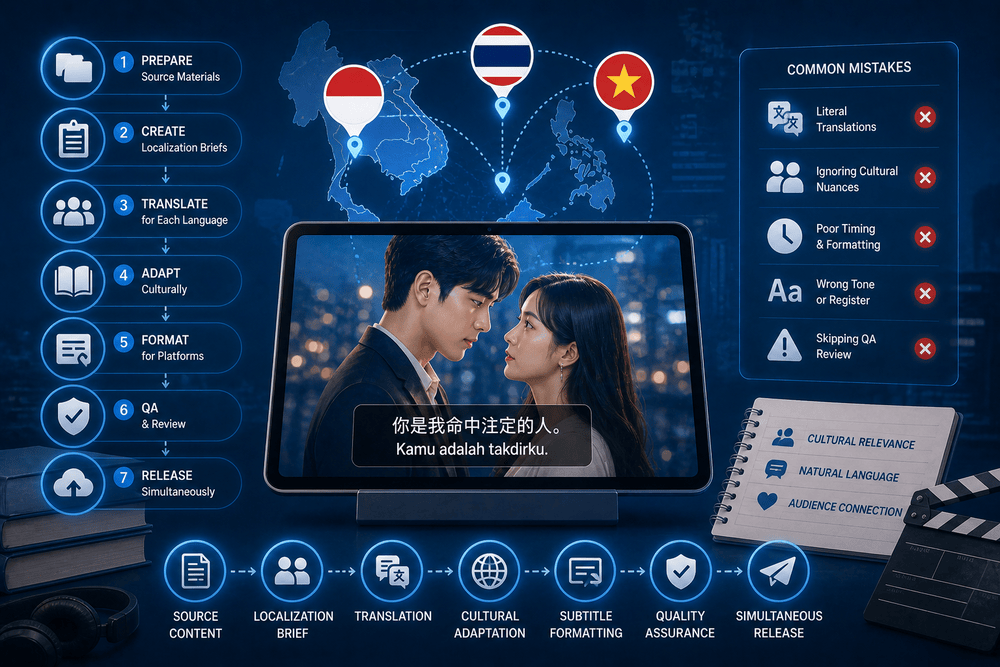
1. Prepare Clean Source Materials Before Localization Begins
All localization work begins with the source content. Ensure that Mandarin source scripts or subtitle files are complete, accurately timed, and free of errors before they enter the localization pipeline. Dialogue that is missing, mistimed, or ambiguous in the source creates downstream quality problems that are multiplied across every language version produced from it. If source scripts are unavailable, professional transcription and time-coding should be completed as a first step.
2. Build Market-Specific Localization Briefs for Each Language
Create a separate localization brief for each of the three target markets. Each brief should define the tonal register appropriate for that audience, cultural references that require adaptation, relationship and honorific language conventions, content elements that may require adjustment for local sensitivities, and any market-specific formatting requirements. A single brief applied across all three languages will produce output that is partially correct for none of them.
3. Address Language-Specific Requirements for Bahasa Indonesia
Bahasa Indonesia localization for Chinese short drama content requires attention to several specific linguistic considerations. Indonesian has a formal and informal register distinction that must be applied consistently based on character relationships and social hierarchy, a key structural element of Chinese drama that maps directly onto Indonesian social conventions. Chinese terms of endearment, family hierarchy titles, and honorifics require culturally equivalent Indonesian expressions rather than literal translations. Slang and colloquial expressions used in contemporary Chinese drama must be adapted to current Indonesian equivalents that resonate with the target demographic.
4. Address Language-Specific Requirements for Thai
Thai localization presents distinct challenges rooted in the language's pronoun system and politeness levels. Thai has an extensive system of gendered and social-register pronouns—the correct selection of which defines the relationship between characters and signals social status, intimacy, and formality. Getting this system wrong undermines the emotional logic of relationship-driven short drama narratives. Additionally, Thai has its own script system that requires careful subtitle formatting for mobile display, including line break logic and reading speed calibration appropriate for Thai readers. Cultural references involving royalty, religion, or social hierarchy require particular care given Thailand's specific cultural sensitivities in these areas.
5. Address Language-Specific Requirements for Vietnamese
Vietnamese localization requires careful handling of the language's pronoun system, which, like Thai, encodes social relationships and age hierarchy directly into everyday address terms. The correct Vietnamese pronoun selection between characters communicates their relationship status, age dynamic, and emotional register in ways that are invisible to non-native speakers but immediately apparent to Vietnamese audiences. Vietnamese subtitle formatting must also account for the language's diacritical mark system, which is essential for meaning but requires font and rendering specifications that support full Unicode display on mobile platforms. Tonal accuracy in Vietnamese text, even in written form, is critical for meaning and must be verified by native-language reviewers.
6. Develop a Series-Level Glossary for Each Target Language
Before episode localization begins, create a controlled glossary for each target language covering character names and how they are addressed in that language, recurring show-specific terms, relationship titles used throughout the series, and any culturally adapted expressions established in earlier episodes. This glossary is the authoritative reference for all translators and reviewers working on that language version and must be maintained and updated as the series progresses.
7. Apply Cultural Adaptation Review Separately for Each Market
Cultural adaptation review is a distinct production step from linguistic translation and must be conducted by a native speaker of each target language who is also familiar with the short drama format and the specific cultural expectations of that market's audience. This reviewer assesses whether the localized content will land emotionally and culturally with the target audience, not just whether it is grammatically correct. This step is what prevents technically accurate translations from producing viewer disengagement due to cultural misalignment.
8. Format Subtitles to Platform and Device Specifications for Each Market
Mobile platform subtitle formatting requirements vary by distribution platform and must be applied to each language version independently. Character limits per line differ between languages; Thai and Vietnamese text at equivalent meaning density is typically longer than Chinese or Indonesian text. Reading speed guidelines must be calibrated for each language. Font rendering specifications must support the full character sets of Thai script and Vietnamese diacritical marks. These technical requirements must be embedded in the production workflow, not applied as corrections at the final stage.
9. Conduct Quality Assurance at the Episode Level for Each Language
QA for each language version should cover timing accuracy, line break correctness, character limit compliance, glossary consistency, cultural accuracy, and technical rendering. Automated subtitle QA tools can handle timing and formatting checks efficiently; cultural and linguistic QA requires native-language human review. Both components are necessary for output that meets the quality standard required to compete in each target market.
10. Plan and Execute Simultaneous Release Across All Three Markets
Where operationally achievable, simultaneous release of localized content across all three markets maximizes the commercial impact of the localization investment, prevents unofficial subtitle versions from establishing audience expectations, and enables the platform to build engagement data across all three markets simultaneously from the first episode.
Common Mistakes When Localizing Chinese Short Drama for These Three Markets
Using a single translator or team for all three languages. Bahasa Indonesia, Thai, and Vietnamese are entirely distinct languages with different scripts, grammar structures, pronoun systems, and cultural frameworks. No single translator or team has native proficiency across all three. Each language requires dedicated qualified resources.
Ignoring honorific and pronoun systems in Thai and Vietnamese. The pronoun and honorific systems in Thai and Vietnamese are not stylistic preferences; they are structural elements of meaning that define character relationships and emotional dynamics. Incorrect pronoun use in either language immediately signals low localization quality to native audiences and undermines the relational storytelling that drives short drama engagement.
Applying Chinese cultural logic directly without adaptation. Chinese short drama frequently references social structures, family dynamics, and relationship conventions that are specific to Chinese culture. Direct transfer of these references without cultural adaptation produces content that feels foreign rather than emotionally resonant to Indonesian, Thai, and Vietnamese audiences.
Treating subtitle formatting as a universal standard. Thai script and Vietnamese diacritical marks have specific technical requirements for mobile display that standard subtitle templates do not automatically accommodate. Platforms that deploy subtitles without verifying rendering across target devices risk delivering content with missing characters, broken diacritics, or illegible text to a portion of their target audience.
Skipping native-language QA in favor of bilingual review only. Review by someone who speaks both Mandarin and the target language is not equivalent to review by a native speaker of the target language with no Mandarin bias. Native-language QA assesses whether the content sounds natural to a monolingual target-market viewer, the actual audience the localization is intended to serve.
FAQ
What is the most important localization consideration for Indonesian audiences watching Chinese short dramas?
Register and relatability. Indonesian audiences respond most strongly to localized content that feels natural and contemporary in Bahasa Indonesia, not formal or stiff. The informal conversational register of short drama dialogue must be matched with equivalent Indonesian expressions that resonate with the target demographic, typically younger mobile-first viewers aged 18 to 35. Character relationship titles and terms of address must map accurately onto Indonesian social conventions for the emotional logic of the drama to land correctly.
Why is Thai subtitle localization more complex than standard translation?
Thai localization complexity stems primarily from the language's pronoun and politeness system, its distinct script, and its specific cultural sensitivities. The Thai pronoun system requires every character interaction to encode social status, gender, and relationship intimacy through pronoun selection, a level of nuance that requires native-language expertise and cannot be reliably handled by generalist translators or machine translation systems. Additionally, Thai script formatting for mobile display requires specific technical configuration that must be verified across target devices and platforms.
Is machine translation a viable starting point for Vietnamese subtitle localization?
Machine translation can produce a rough draft for Vietnamese that reduces initial translation time, but it consistently fails on Vietnamese tonal accuracy, pronoun selection, and cultural adaptation, the three areas that most directly determine whether Vietnamese audiences engage with the content or abandon it. Any machine translation output used in a professional localization workflow must undergo comprehensive native-language review and cultural adaptation before it meets the quality standard required for competitive streaming distribution in Vietnam.
How much does it cost to localize a Chinese short drama series into all three languages simultaneously?
Localization cost depends on episode length, volume, format (subtitle versus dubbing), complexity of source content, and whether translation memory and terminology infrastructure is already in place for the series. Subtitle localization is significantly more cost-efficient than dubbing and scales favorably as episode volume increases through translation memory reuse. A professional localization partner can provide market-specific pricing based on your content specifications and release requirements.
Localizing Chinese Short Drama for Southeast Asia with a Regional Expert
For streaming platforms and content producers localizing Chinese short drama series into Bahasa Indonesia, Thai, and Vietnamese simultaneously, the operational complexity of maintaining quality, consistency, and release pace across three distinct language workflows is most effectively managed through a professional localization partner with dedicated regional expertise.
Digital Trans Asia provides professional translation, interpretation, and localization services for businesses across Asia. With native-language capacity across the major languages of Southeast Asia, including Bahasa Indonesia, Thai, and Vietnamese, and direct experience in episodic short drama localization for streaming platforms and digital content distributors, Digital Trans Asia supports content businesses in delivering market-specific localization that competes effectively in each target market.
Conclusion
Localizing Chinese short drama series for Indonesian, Thai, and Vietnamese audiences is a market-specific discipline, not a regional translation exercise. Each of the three markets has distinct linguistic structures, cultural frameworks, and technical requirements that determine whether localized content retains viewers or loses them. Platforms and producers that invest in dedicated, market-specific localization workflows, with native-language translators, cultural adaptation review, series-level terminology management, and platform-specific formatting, are the ones building sustainable audience growth across Southeast Asia's most commercially valuable short drama markets. The investment is operationally demanding, but the audience reach, viewer retention, and competitive positioning it delivers make it the clearest growth lever available to content businesses entering the region.
Ready to localize your Chinese short drama series for Indonesian, Thai, and Vietnamese audiences with expert localization? Visit https://digital-trans.asia/ to learn more about our services. Contact us today to get started!