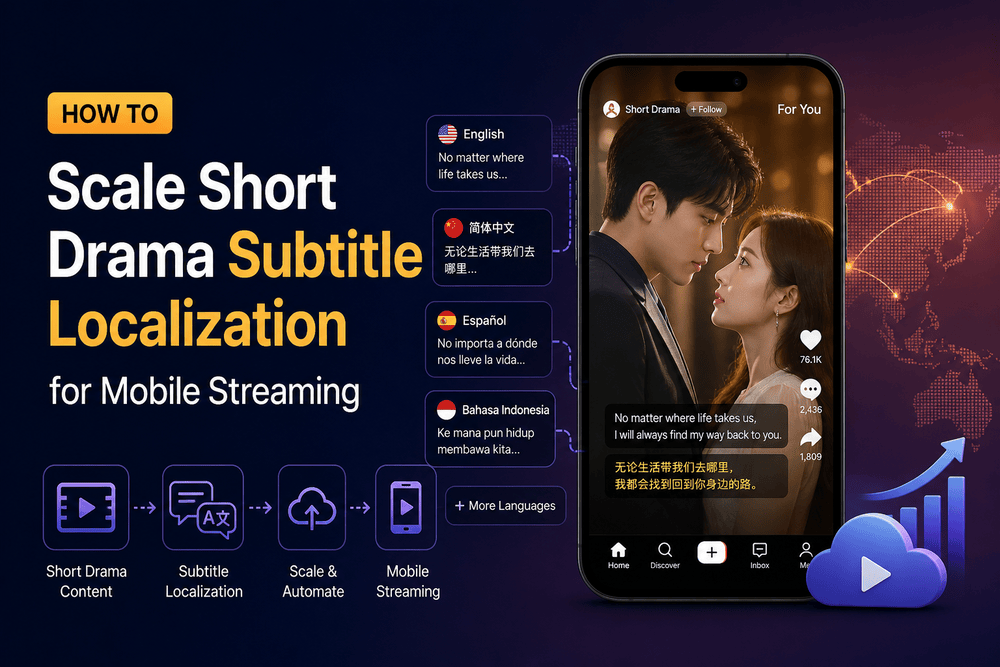
How to Scale Short Drama Subtitle Localization Across Multiple Languages for Mobile Streaming
Scaling short drama subtitle localization across multiple languages is the process of systematically adapting subtitle content from a source language into several target languages simultaneously, using a structured workflow that maintains consistency, speed, and quality across all versions. For mobile streaming platforms distributing short-form drama content globally, this is not a creative exercise; it is an operational requirement tied directly to audience growth and content performance.
Short drama content is expanding rapidly across Southeast Asia, with platforms in Indonesia, Thailand, Vietnam, Malaysia, and the Philippines competing for mobile-first audiences who consume episodic content in short bursts. Without localized subtitles that are accurate, culturally adapted, and delivered at pace with content release schedules, platforms lose viewers at the point of discovery. Localization at scale is what separates platforms that grow across borders from those that stall at regional boundaries.
This article provides a practical framework for streaming platforms, content operators, and digital publishers looking to build or optimize a multilingual subtitle localization pipeline for short drama content.
What Is Short Drama Subtitle Localization at Scale
Short drama subtitle localization at scale refers to the end-to-end process of converting subtitle files from a source language into multiple target languages simultaneously, across a high volume of short-form episodic content, while maintaining brand consistency, linguistic accuracy, and platform-specific formatting requirements.
Unlike feature film localization, where a single project may take weeks, short drama content often follows a release cadence of daily or weekly episodes across multiple series. This demands a localization workflow that is modular, repeatable, and capable of handling concurrent language outputs without sacrificing quality.
Scalable subtitle localization typically involves a combination of translation memory systems, terminology management, cultural adaptation review, and platform-specific subtitle formatting, all coordinated within a structured project management framework.
Business Impact of Multilingual Subtitle Localization for Short Drama Platforms
Investing in scalable subtitle localization directly affects the metrics that matter most to content platforms and streaming businesses.
-
Audience reach expansion: Localized subtitles open content to audiences who cannot consume it in the source language, increasing total addressable market without producing new content.
-
Viewer retention and completion rates: Audiences who understand content natively complete more episodes, increasing platform engagement metrics and algorithmic content performance.
-
Platform subscriber growth: Multilingual content libraries attract and retain subscribers from multiple markets, reducing churn in non-source-language regions.
-
Content licensing value: Well-localized content is more attractive to distribution partners and licensing buyers across international markets.
-
Revenue from underserved language markets: Southeast Asian languages such as Bahasa Indonesia, Thai, Vietnamese, and Tagalog represent large mobile-first audiences with growing streaming consumption but limited localized content supply.
-
Simultaneous multi-market release capability: A scalable localization pipeline allows platforms to release content across markets at the same time, eliminating the competitive disadvantage of delayed regional rollouts.
How to Scale Short Drama Subtitle Localization: A Step-by-Step Process
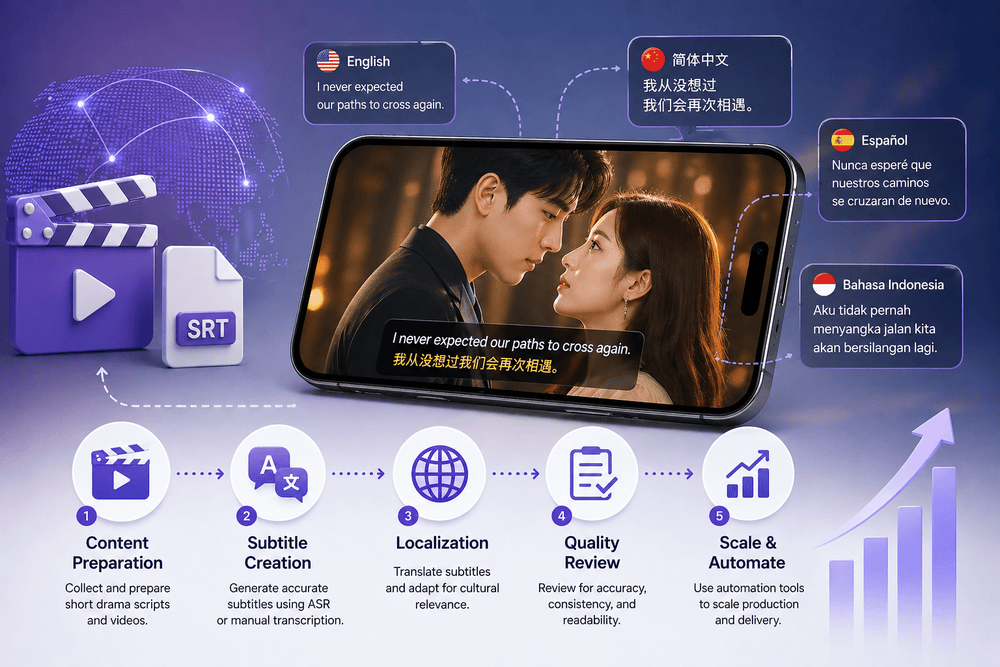
1. Standardize Source Content Before Localization Begins
Before sending content for localization, ensure that source subtitle files are clean, properly timed, and formatted to platform specifications. Poorly prepared source files multiply errors across every language version produced from them.
2. Define Target Language Priority by Market
Not all languages carry equal commercial value for every platform. Identify which language markets have the highest growth potential or existing user base and prioritize accordingly. For SEA-focused platforms, Bahasa Indonesia, Thai, Vietnamese, and Filipino are typically first-tier priorities.
3. Build a Centralized Terminology and Style Guide
Create a glossary of show-specific terms, character names, recurring phrases, and brand language for each series. This reference document ensures consistency across episodes, seasons, and translator teams, regardless of project volume.
4. Implement Translation Memory Systems
Translation memory (TM) tools store previously translated segments and reuse them automatically when identical or similar content appears again. For episodic short drama content, where recurring dialogue patterns, character catchphrases, and show-specific language are common, TM significantly reduces cost and turnaround time as volume increases.
5. Assign Language-Specific Review at the Cultural Level
Linguistic accuracy is not enough for short drama content that relies on emotional tone and cultural context. Each language version should be reviewed by a native-speaking editor with knowledge of local cultural conventions, idioms, and audience expectations, particularly for romantic, comedic, or dramatic dialogue that does not translate literally.
6. Apply Platform-Specific Subtitle Formatting
Mobile streaming platforms have distinct technical requirements for subtitle files: character limits per line, reading speed guidelines, font rendering specifications, and timing offsets. A scalable workflow must embed these technical parameters into the production process rather than address them at the end.
7. Use a Quality Assurance Checklist for Every Language Version
QA for subtitles at scale should cover timing accuracy, line break logic, character limit compliance, spelling and grammar consistency, and terminology alignment with the approved glossary. Automating parts of this process through subtitle-specific QA tools reduces manual review time without reducing output quality.
8. Establish a Scalable Vendor or Partner Model
As content volume increases, in-house teams alone cannot sustain throughput. Working with a professional localization partner that has dedicated capacity for multiple Southeast Asian languages and experience with episodic short-form content is essential for maintaining pace with release schedules.
Common Mistakes When Scaling Short Drama Subtitle Localization
Relying solely on machine translation without human review: AI translation tools can handle volume, but they consistently fail on culturally specific dialogue, slang, and emotional tone that are central to short drama content. Deploying raw machine translation as a finished product creates audience disengagement and platform reputation risk.
Starting localization from low-quality source files: If source subtitles contain timing errors, missing segments, or formatting inconsistencies, these problems are replicated and amplified across every language version produced.
Treating all Southeast Asian languages as interchangeable: Each target language in the region has distinct formality registers, cultural references, and audience expectations. A one-size-fits-all brief for all SEA languages produces low-quality output in every one of them.
Skipping terminology management for episodic content: Without a controlled glossary, different episodes of the same series may use different character name spellings, inconsistent show-specific terms, or contradictory translations for recurring phrases, undermining continuity and viewer experience.
Underestimating turnaround time for quality output: Platforms that build localization timelines around machine translation speed and then demand human quality end up with neither. Realistic scheduling that accounts for human translation, review, and QA must be built into the content release plan.
FAQ
What is the difference between subtitle translation and subtitle localization?
Subtitle translation converts dialogue text from one language to another. Subtitle localization goes further; it adapts cultural references, humor, idioms, and tone so that the content resonates with the target audience as naturally as it does with the original audience. For short drama content, localization is always the appropriate standard.
How many languages can a short drama series realistically be localized into simultaneously?
With a structured workflow and professional localization partner, a short drama series can be localized into five to ten languages simultaneously without sacrificing quality. The key variables are source file readiness, glossary completeness, and the availability of qualified reviewers for each target language.
Is AI subtitle translation good enough for professional short drama platforms?
AI tools can accelerate the first draft of subtitle translation, but they are not sufficient as a standalone solution for short drama content. Emotional tone, culturally specific dialogue, and rapid conversational exchanges, all hallmarks of the short drama format, require human review and cultural adaptation to meet the quality standard that retains viewers and supports platform growth.
When should a streaming platform invest in a scalable localization infrastructure?
The right time to build a scalable subtitle localization workflow is before content volume exceeds what ad hoc solutions can handle, not after. Platforms planning multi-market content releases or entering new language markets should establish localization processes and partner relationships before the demand surge, not in response to it.
How Professional Localization Partners Support Platform Growth at Scale
For streaming platforms managing high-volume short drama content across multiple Southeast Asian markets, the operational complexity of subtitle localization at scale is best managed through a dedicated professional partner rather than an internal team or generalist translation vendor.
Digital Trans Asia provides professional translation, interpretation, and localization services for businesses across Asia. With dedicated capability in Southeast Asian languages and experience in episodic content localization, Digital Trans Asia supports streaming platforms and content distributors in building reliable, scalable subtitle workflows that meet release schedules without compromising quality.
Conclusion
Scaling short drama subtitle localization across multiple languages is a business-critical capability for any streaming platform competing in the Southeast Asian market. The platforms that grow fastest are those that treat multilingual subtitle localization not as a post-production afterthought, but as an integrated part of their content distribution strategy. A structured workflow, built on clean source files, translation memory, cultural review, and platform-specific formatting, makes it possible to release localized content across multiple languages simultaneously, at the pace that mobile audiences demand. The investment in scalable localization infrastructure directly translates into wider audience reach, higher retention rates, and stronger competitive positioning across the region.
Ready to scale your short drama content across Asian markets with expert subtitle localization? Visit https://digital-trans.asia/ to learn more about our services. Contact us today to get started!