How Age-Appropriate Dubbing Elevates Children’s Learning Experiences
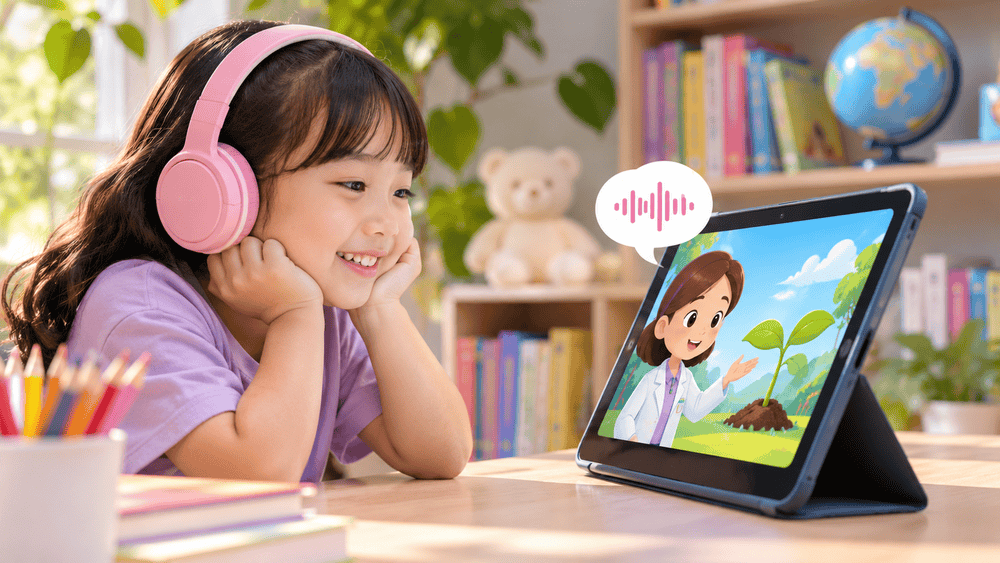
Children learn best when educational content feels understandable, engaging, and relevant to their everyday lives. However, even a well-designed video is difficult to follow when its language, vocabulary, or delivery does not match a child’s developmental stage. Age-appropriate dubbing resolves this issue by creating a viewing experience that helps children understand, participate, and remember what they learn.
What Is Age-Appropriate Dubbing?
Age-appropriate dubbing is the process of replacing a video’s original dialogue with a translated or adapted voice track designed for a specific age group. It considers more than language accuracy since the vocabulary, sentence length, tone, pronunciation, pacing, and emotional delivery should all be suitable for the intended audience.
For instance, a science video for preschoolers might explain evaporation using simple phrases such as “The water turns into vapor when it gets warm.” Meanwhile, a video for older children introduces more precise terminology, such as “Evaporation happens when liquid water changes into gas.” Both explanations communicate the same concept, but the second may be more suitable for children who already understand basic scientific vocabulary.
The importance of language accessibility is supported by UNESCO’s 2023 report on early childhood language acquisition, which identifies language skills as critical predictors of academic and social outcomes. The report also emphasizes the role of high-quality early education in supporting children’s development.
This does not mean that every child of the same age learns in exactly the same way. Age is a useful starting point, but effective dubbing should also consider language proficiency, learning needs, and the complexity of the subject.
Why Does the Original Language Matter?
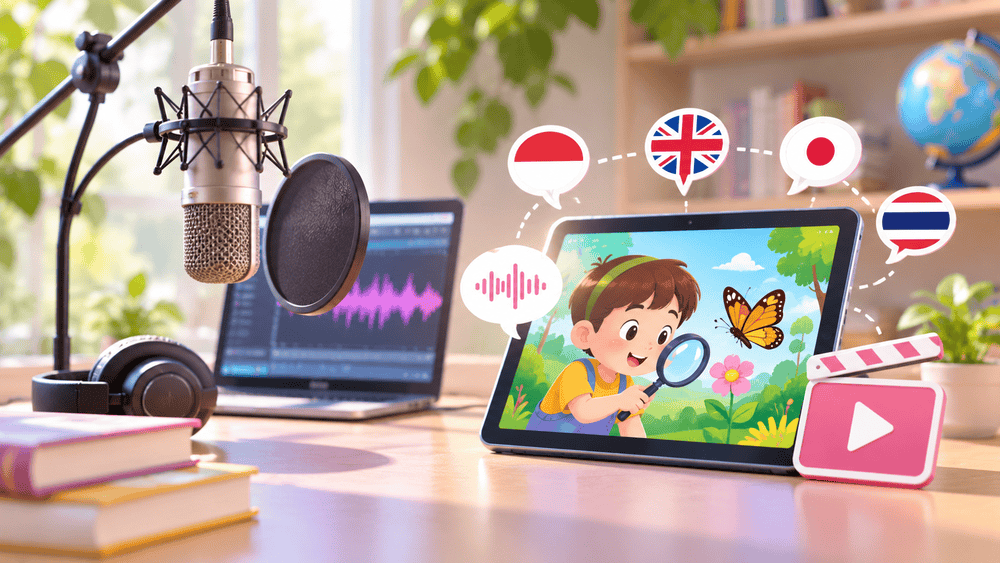
When children watch content in a language they understand, they will focus more easily on the lesson itself. They do not have to spend as much mental effort trying to decode unfamiliar words or follow complicated instructions. It is in line with UNICEF’s language-of-instruction resources that explain that teaching children in languages they understand is essential for developing foundational literacy and numeracy skills.
For educational video producers, this underscores the fact that dubbing is able to reduce language barriers while preserving the visual explanations, demonstrations, and storytelling that make video learning effective.
Benefits and Use Cases of Age-Appropriate Dubbing
Age-appropriate dubbing supports different learning goals, from early vocabulary development to subject-specific education. When the translated dialogue is carefully matched to the child’s developmental needs, it elevates its value.
-
Makes educational content easier to understand: Children can follow explanations, instructions, and stories in a familiar language. This is particularly useful for early learners and children who are still developing proficiency in the original language.
-
Supports vocabulary development: Repeated exposure to clear, meaningful words help children connect spoken language with objects, actions, and concepts. For instance, a dubbed nature video introduces words such as “leaf,” “root,” and “grow,” while showing the relevant visuals.
-
Encourages independent learning: When children understand the narration, they may be able to revisit lessons, follow activities, and explore new topics with less assistance from adults. So, educational content is more useful at home and in informal learning environments.
-
Improves access to multilingual education: Dubbing allows educational content to reach children who speak different languages without requiring every learner to rely on subtitles or an adult translator. UNESCO’s work on mother-tongue-based multilingual education highlights the value of supporting children’s home languages during the early years.
-
Helps children connect learning with everyday life: Localized examples, familiar expressions, and natural dialogue make abstract concepts feel more relevant. A lesson about weather, for instance, may be easier to understand when the language reflects how children commonly describe rain, heat, or storms.
-
Supports inclusive educational media: Dubbing makes content more accessible to children who are not yet confident readers. This is especially relevant for preschool and early-primary audiences, who may find subtitles difficult to process while also watching visual content.
-
Creates opportunities for repeated learning: Children can replay a song, story, or explanation in a language they understand. Repetition can be useful for reinforcing vocabulary, routines, and basic concepts.
A practical example comes from Sesame Workshop’s Watch, Play, Learn initiative. The program includes 140 short educational videos designed for children aged 3–8, covering areas such as mathematics, science, and social-emotional learning. The content was being dubbed into 13 languages, demonstrating how multilingual adaptation assists the wider distribution of early-learning resources.
Moreover, a 2023 doctoral thesis from NOVA University of Lisbon examined how educational videos help preschool learning, including whether dubbed content is as effective as content in the original language. The research involved 186 Portuguese preschool children and 134 families across five studies. Its broader findings suggest that cognitive and pedagogical strategies, as well as children’s engagement, can elevate learning from educational videos. However, the thesis recommends privileging local productions over dubbed content, so it should not be cited as evidence that dubbing itself improves learning outcomes. Instead, it highlights the importance of evaluating localization choices carefully and considering whether the adapted content encourages the intended learning experience.
How Age-Appropriate Dubbing Works
Creating effective dubbed educational content requires the combination of linguistic accuracy, child-development considerations, and audiovisual quality. Here is the typical workflow:
-
Define the target age group and learning objectives. Start by identifying who the content is for and what children should learn from it. A video for toddlers may focus on simple vocabulary and routines, while a lesson for older children may require more technical language.
-
Review the original script and visuals. Translators and localization specialists examine the dialogue, on-screen text, demonstrations, and cultural references. This helps them identify which elements can be translated directly and which require adaptation.
-
Adapt the language for the intended audience. The script should use vocabulary, sentence structures, and expressions that children reasonably understand. This may involve shortening long sentences, replacing unfamiliar idioms, or explaining concepts in a more natural way.
-
Match the dialogue to the visuals and timing. The translated script must fit the original video. If a character points to a red apple while saying “This is a red apple,” the dubbed dialogue should remain synchronized with the action. Timing is especially crucial in educational content as children often rely on the relationship between what they hear and what they see.
-
Cast suitable voice actors. Voice actors should be able to deliver dialogue naturally for the intended audience. A preschool video may benefit from a warm, expressive delivery, while a science lesson for older children may require a calm and clear instructional tone.
-
Record and mix the dubbed audio. The new dialogue is recorded and integrated with the original sound effects and music. Audio quality matters since unclear pronunciation, excessive background music, or inconsistent volume creates learning difficulty.
-
Review the content for accuracy, clarity, and appropriateness. A quality review should check whether the translation preserves the educational meaning, whether the language is suitable for children, and whether the dialogue remains synchronized with the visuals.
-
Test the content with the intended audience when possible. Feedback from children, caregivers, educators, or language specialists will reveal problems that may not be obvious during translation. For instance, a phrase that sounds natural to adults may still be confusing to young learners.
Common Mistakes and Risks of Age-Appropriate Dubbing
Knowing several common mistakes and risks of age-appropriate dubbing and avoiding them elevates the value of the dubbed educational content.
Using language that is too advanced
A technically correct translation may contain long sentences, unfamiliar vocabulary, or abstract expressions that are difficult for children to understand. The solution is to simplify where appropriate without removing essential learning concepts.
Making the dialogue too childish
Age-appropriate does not mean overly simplistic. Children should still be exposed to meaningful vocabulary and accurate information. The goal is to make concepts accessible, not to underestimate the audience.
Translating idioms literally
Expressions that work in one language may sound confusing or unnatural in another. Therefore, a literal translation distracts children from the lesson. Localized phrasing is often more effective when it preserves the intended meaning.
Ignoring cultural context
Names, examples, jokes, gestures, and references may not have the same meaning across cultures. Localization should help children understand the content while respecting the original educational purpose.
Prioritizing lip-sync over clarity
Matching mouth movements is a useful technique, but forcing a translation into an unnatural sentence may reduce comprehension. For educational videos, clear and natural speech should generally take priority.
Using an unsuitable voice or delivery style
A voice that is too fast, dramatic, or difficult to understand distracts learners from the lesson. The delivery should match the content and the developmental needs of the audience.
Treating dubbing as a replacement for interaction
Dubbing improves access to educational content, but it should not be treated as a substitute for meaningful interaction with caregivers, teachers, or other children. Research on early language development emphasizes the significance of interpersonal relationships and language-rich environments.
Assuming that all screen time is educational
A dubbed video may be easier to understand, but that does not automatically make it high-quality learning content. A 2024 study published in JAMA Pediatrics found that increased screen time was associated with fewer adult words heard, child vocalizations, and conversational exchanges among young children. The findings reinforce the urgency of balancing screen-based learning with real-world interaction.
Frequently Asked Questions
Is age-appropriate dubbing only useful for preschool children?
It delivers benefits to children across different age groups. The main difference is the level of language complexity, vocabulary, and delivery style. A preschool video may require short sentences and repetition, while content for older children can introduce more advanced terminology.
Does dubbing help children learn a second language?
It can be beneficial for language exposure, especially when children hear clear pronunciation and meaningful vocabulary. However, dubbing alone is not a complete language-learning method. It works best when combined with activities such as conversation, reading, and opportunities to use the language.
Is dubbing better than subtitles for children?
It depends on the child’s age, reading ability, and learning goals. Dubbing is particularly useful for younger children who are not yet confident readers. Meanwhile, subtitles may be more suitable for older learners who are able to read comfortably and benefit from seeing written language alongside the audio.
How can content creators ensure their dubbing is educationally effective?
They should begin with clear learning objectives, use language appropriate for the target audience, preserve the meaning of the original lesson, and review the final content for clarity and synchronization. Testing with educators or children also helps identify problems before release.
Why Professional Localization Partners Matter for Age-Appropriate Dubbing
Digital-Trans Asia provides professional translation, interpretation, and localization services for businesses across Asia. Partnering with experienced language service providers help ensure your content reaches young audiences with the right language, tone, and learning experience.
Conclusion
Age-appropriate dubbing transforms educational videos from content that children merely watch into content they can easily understand and engage with. By adapting vocabulary, sentence structure, tone, and delivery to the intended audience, dubbing services reduce language barriers and enable more accessible learning.
The strongest results come from treating dubbing as part of the educational design process. When language adaptation is combined with accurate content, clear visuals, natural voice acting, and meaningful interaction, dubbed videos gain valuable resources for multilingual learning.
It is clear that investing in age-appropriate dubbing boosts educational content to reach more children while making the learning experience more understandable, inclusive, and engaging.