How Dubbing Helps Children’s Educational Content Reach Global Audiences
Educational content introduces children to mathematics, science, language, and social-emotional skills. However, when those lessons are available only in one language, many children may struggle to understand them fully. Dubbing services help educational creators overcome this barrier by replacing the original dialogue with a translated voice track that sounds natural in the target language.
As online learning continues to expand, dubbing has become a crucial element of making children’s educational videos more accessible, engaging, and culturally relevant. From animated science lessons to early-learning programs, localized audio helps children understand content in a language they are familiar with.
What Is Dubbing and Why Does It Matter for Children’s Educational Content?
Dubbing is the process of replacing the original spoken dialogue in a video with a new voice recording in another language. In other words, dubbing allows children to hear the lesson directly in their preferred language.
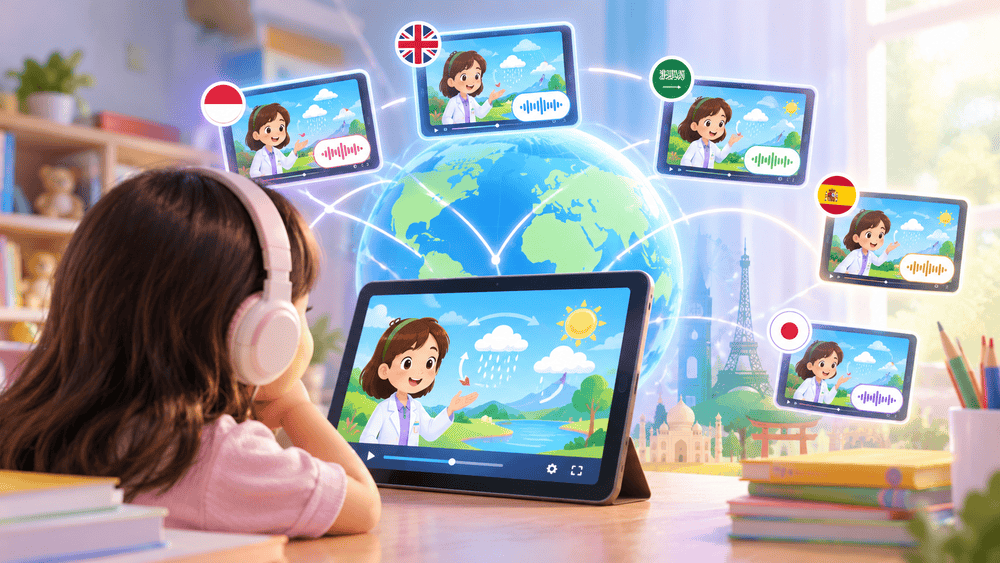
For instance, an English-language video explaining the water cycle could be dubbed into Indonesian, Arabic, or Spanish. The visuals remain largely the same, but the narration, character dialogue, and sometimes on-screen text are adapted for the target audience.
This distinction matters since young children are still developing their reading skills. Early learners may not be able to read subtitles quickly enough to follow a fast-paced explanation. Dubbing can therefore make educational content easier to follow, especially when lessons depend on listening, repetition, and visual demonstrations.
The value of localized educational media is supported by research. UNESCO’s documentation of Sesame Workshop’s Watch, Play, Learn initiative explains that its early-learning videos were designed for children aged 3–8 and covered mathematics, science, social-emotional learning, and child protection, health, and safety. The project was being dubbed into 13 languages to support distribution across different regions.
The same UNESCO source also reports that a 15-country meta-analysis found that children who watched local versions of Sesame Street showed improved cognitive and social learning outcomes, with particularly pronounced benefits among disadvantaged children. This suggests that culturally and linguistically adapted educational media support learning outcomes.
For creators, the implication is clear that dubbing is not simply a translation feature, but a way to make educational content more usable for children who speak different languages.
Benefits and Use Cases of Dubbing for Children’s Educational Content
Dubbing supports both educational goals and international content distribution. However, its value depends on how well the localization matches the learners’ needs.
1. Makes Learning More Accessible
Children learn more effectively when they understand the language used to explain a concept. For instance, a phonics video can be adapted into a local language, so children will focus on the sounds and meanings being taught rather than trying to decode unfamiliar speech.
2. Supports Online Learning Across Different Regions
Dubbing services help educational platforms distribute the same learning materials across multiple countries.
UNICEF’s Learning Passport is an example of how localized digital education assists children in different learning environments, especially in crisis-affected settings. Developed with Microsoft and partners, the platform provides online and offline access to educational content and is adaptable to national learning systems.
For educational publishers, this means a single video library can potentially serve multiple markets without requiring entirely separate productions for every language.
3. Elevates Engagement and Comprehension
Children are more likely to stay engaged when educational content feels familiar and easy to understand. Simply put, the learning experience feels less like a translation and more like content created for the child.
Additionally, UNICEF’s review of digital learning solutions emphasizes that technology is most effective when it is connected to educational goals and supported by appropriate implementation.
4. Helps Educational Content Reach Underserved Audiences
Dubbing can be particularly valuable when educational content is distributed through public learning platforms, television, or mobile devices. In other words, it is relevant not only to commercial children’s content, but also to public education initiatives, nonprofit programs, and organizations working in multilingual communities.
UNESCO, UNICEF, and ITU’s 2026 Charter for Public Digital Learning Platforms identifies multilingual support, accessibility, and age-appropriate content as critical principles for inclusive digital education.
5. Creates Opportunities for Global Content Expansion
For educational content creators, dubbing provides opportunities to license, distribute, or promote videos in new markets.
A successful educational series may be adapted for different languages while retaining its original animation, characters, and curriculum structure. In simple words, international expansion is more practical than producing a completely new series for every market, provided that the content remains educationally relevant and the language adaptation meets high standards.
How Dubbing Works for Children’s Educational Content
A successful dubbing project involves more than translating a script. It requires coordination between language specialists, voice talent, audio engineers, and educational reviewers. Here is the typical workflow:
- Review the Original Content
The process begins with an assessment of the video’s purpose, target age group, learning objectives, and intended audience.
For educational content, this stage is especially essential as a translation must preserve the meaning of the lesson.
- Translate and Adapt the Script
The original script is translated into the target language and adapted for natural speech using vocabulary that matches the children’s age and language level.
A literal translation may not always be appropriate. For instance, a phrase that sounds natural in English may feel awkward or confusing when translated word for word into another language.
- Record the New Voice Track
Professional voice actors record the translated dialogue while following the original timing and emotional tone.
For children’s educational videos, voice quality matters. A narrator should sound clear, friendly, and engaging without becoming distracting. Character voices should also remain consistent across episodes.
- Synchronize Audio with the Video
The recorded dialogue is edited to match the original timing, including pauses, character movements, and scene transitions. Good synchronization helps maintain the rhythm of the lesson and prevents the audio from feeling rushed or disconnected from the visuals.
This process may require modifications to the translated script since some languages take longer to express the same idea.
- Review Educational and Linguistic Quality
Before release, the localized video should be reviewed by language specialists and, ideally, educational experts familiar with the target audience. Besides linguistic elements, they need to check consistency with the original lesson, as well as audio quality and synchronization. The aim is to ensure that the video remains both educationally accurate and enjoyable to watch.
Common Mistakes and Risks in Dubbing Educational Content
Dubbing is able to expand the reach of educational content, but poor localization may reduce its effectiveness. Here are several common mistakes to avoid.
Translating Too Literally
While word-for-word translation may preserve the original sentence structure, it often loses its intended meaning. Educational scripts should instead be adapted for natural speech, especially when explaining concepts to young children.
Ignoring the Target Age Group
A translation that works for adults may be too complicated for preschoolers. Vocabulary, sentence length, tone, and speaking speed should match the children’s developmental level.
Choosing Voices That Do Not Fit the Content
A voice that sounds too serious, too fast, or too dramatic may distract children from the lesson. Consequently, voice casting should consider the narrator’s clarity, warmth, and ability to maintain attention.
Overlooking Cultural Context
Examples, humor, names, and expressions may not work equally well in every market. Localization should preserve the educational purpose while adapting references that could confuse or alienate the audience.
Treating Dubbing as a Substitute for Educational Quality
Dubbing makes content more accessible, but it cannot fix unclear explanations, inaccurate information, or weak instructional design. UNESCO’s digital learning guidance emphasizes that educational platforms should prioritize accurate, reliable, age-appropriate, and pedagogically sound content.
Frequently Asked Questions
Is dubbing better than subtitles for children’s educational videos?
Dubbing can be more suitable for younger children as it allows them to listen without needing to read subtitles. However, subtitles support literacy and language learning. The best choice depends on the children’s age, reading ability, and learning objectives.
Can dubbed educational videos support independent learning?
A 2024 systematic review of 93 studies found that high-quality educational videos help children learn specific language skills, with repeated exposure supporting learning in some studies (published by Frontiers in Psychology). For instance, a child will replay a dubbed science explanation or counting activity to practice new concepts. Dubbing makes these activities easier to follow in a familiar language, while working best as a supplement to classroom instruction and other online learning activities.
Does dubbing need to change the educational content?
Not necessarily, since the main goal is to preserve the original learning objectives while adapting the language, examples, and expressions for the target audience. Any changes should maintain educational accuracy.
What should creators look for in dubbing services?
Creators should look for providers with experience in children’s content, professional voice talent, accurate translation, audio synchronization, and educational quality control. A strong provider should understand that dubbing educational content requires both language expertise and attention to learning outcomes.
Why Professional Localization Partners Matter for Dubbed Children’s Educational Content
Looking to make your children’s educational videos more accessible to global audiences? Digital-Trans Asia provides professional translation, interpretation, and localization services for businesses across Asia.
Professional dubbing services will help you adapt your content naturally, preserve its educational value, and connect with learners in their preferred language.
Conclusion
Dubbing helps children’s educational content reach global audiences by removing language barriers and making lessons easier to understand. Through well-executed localization, it enhances accessibility, improves engagement, and helps educational platforms distribute content across different regions.
The strongest dubbing projects combine accurate translation, age-appropriate language, natural voice acting, and careful synchronization. They also recognize that educational localization is about preserving the meaning and purpose of the lesson.
As online learning continues to expand, dubbing services play a significant role in making high-quality educational content available to more children. For creators and education providers, investing in thoughtful localization is a practical step toward building a more inclusive global learning experience.