
Website Localization Services: What They Are, Benefits, and How to Choose
Companies that prioritize customer experience have reported revenue increases of up to 80%. This highlights how strongly customer satisfaction can influence business growth. To achieve this, you will have to undertake website localization of your web page.
This is the problem: there are plenty of localization companies on the market, and choosing one can be complicated because traditional translation agencies and modern companies using AI technologies offer localization services. In this article, we will discuss what localization services for a website are, their main benefits, and how to choose one.
Website Localization Services: What Are They?
Website localization can be defined as the process of adapting a website for a particular market in relation to the language, culture, and preferences of its audience. So, it requires not only translating all website text but also adapting graphics, currencies, date formats, cultural elements, interface design, and more.
Professional providers can do that by performing all necessary translations, localizing cultural aspects, and launching localized pages through a content management system.
They also perform optimization of website content for local search by researching keywords and search engines in each country. Websites are constantly evolving, and localization services may also update their translated material on an ongoing basis.
It should be pointed out that localization of websites and internationalization differ from each other in the sense that the latter focuses on changes in website design in order to ensure that the website can work in different languages and in different regions. If the localization process goes well, the business will make sure that clients all over the world will feel comfortable while exploring the website.
Website Localization vs Translation
Both website localization and translation are related to each other. However, the purpose of these processes is different. The difference between the two processes is that translation of the website implies transfer of the message into another language, while localization of the website presupposes adaptation of the website to the needs of the audience.
For example, when the product page is translated from one language into another, it doesn't necessarily mean that the prices and addresses are adjusted properly.
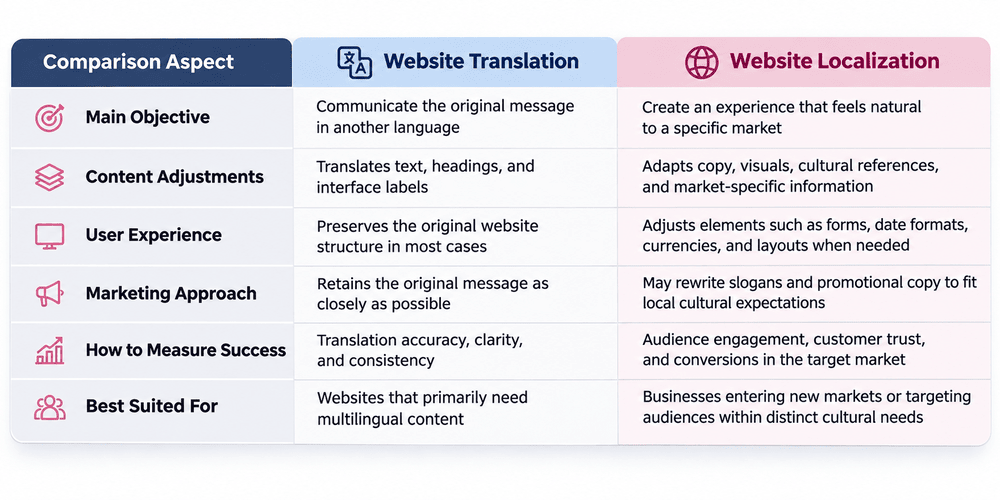
This is why the website localization process focuses not only on language accuracy but also on various aspects of culture and on user experience and marketing requirements of the audience.
It is important to mention that choosing correct wording is crucial for branding purposes since in one language, the slogan conveys the right message, while in another language it may sound very banal.
Therefore, one of the options available for companies is transcreation, which is describing the process of recreating marketing content for giving the same meaning without translating each word literally.
Read more: Why Indonesian Localization Matters for Global Platforms
4 Benefits of Website Localization Service for Your Business
The right website localization service can help your business grow globally in various ways. Here are the key benefits:
1. Speak Your Customers’ Language
If you have a multilingual website, your business will be able to communicate with individuals who would like to use their native language while searching or purchasing online. By having your website localized with languages such as Chinese, Japanese, Malay, Tagalog, Arabic, and Korean, you can attract more clients to your website.
Moreover, by having your website professionally localized, you will be able to adapt the content on your website to the individual requirements of your clients. Hence, your clients will be able to interact with your company more easily.
2. Improve Your Visibility in Local Search Results
Only translating your webpage may not be sufficient to gather international traffic. You would also need localized keywords, appropriate metadata, and correctly configured hreflang tags, which enable search engines to show accurate pages to users from various regions.
Without such elements, your localized pages may not perform well in competing in the search results against other translations of your webpage. A proper localization plan makes our content closer to your potential consumers’ local search behavior and helps reach them whenever they are searching for similar products.
3. Build Trust and Encourage More Conversions
Generally, people usually become more relaxed when there are product descriptions, prices, and payments that can be explained in terms they are familiar with. The behavior is highly magnified when people have to consider other elements associated with the purchase process, such as payments, security, and the legality of the transaction.
4. Boost Revenue
Website localization could also prove helpful in increasing revenue because a positive user experience will be created throughout the entire purchasing process. Users will feel more comfortable when they have access to product information, price comparison, and ordering information in their native language.
The localization of a website in accordance with the requirements and needs of local people would prevent confusion and create more successful transactions.
How to Choose the Best One
Comparing prices is never enough when selecting a service provider. Rather, you need to deal with someone who knows your goals for your business, your site, and the intended audience. Below are some important things you should consider during the localization process:
1. Define Your Goals and Project Scope First
First, identify your needs before selecting a website localization service provider. It could be anything from a rise in international sales, improved clarity of customer support material, to localization of marketing campaigns for new markets. Here are some questions that must be answered.
- Targeting Countries and Languages: Which countries and which languages do you want to target?
- Scope of the Localization Project: Do you need only one-time localization or regular localization services?
- Nature of the Text: Which kind of texts would you like to localize? Web pages, PDFs, videos, or images?
- Main concerns: Is speed, linguistic accuracy, or cultural significance more significant to you?
2. Evaluate Their Experience With Your Website Type
The localization strategies for different websites can vary. An eCommerce site should focus mainly on product descriptions and purchasing processes, while a SaaS product needs translation of its interface or manuals. Therefore, prior to choosing a localization partner, one should consider the following aspects:
- The provider’s knowledge of the industry and the type of website.
- The provider’s attitude to cultural and linguistic aspects of the target market.
- The potential to see case studies, customer reviews, or some project samples.
Knowing the industry might decrease the number of changes made throughout the process.
3. Look Beyond Translation Capabilities
A good website localization service should tailor the whole experience of the visitor to their local expectations and not merely translate the site into another language. See if the service can do the following:
- Customize graphics, color schemes, and other design aspects to fit the culture.
- Redo the calls to action based on how locals behave as customers.
- Localize the currencies, date formats, and legal information according to the local market needs.
For example, the Japanese business community would need a more formal language style, while the Southeast Asian countries could be sensitive about their culture and images. It is the job of a competent service provider to take into account such considerations so that your website appears natural to the locals. Digital Trans Asia provides professional translation, interpretation, and localization services for businesses across Asia.
4. Check Their Localization Workflow
Reliable website localization companies also provide a clear workflow regarding the translation, quality assurance, technical implementation, and future updates. You can find out how they ensure consistency across all pages and revisions during the update of your website. This information allows you to choose a firm that will have the ability to work with your website immediately after its creation and then help you develop it globally.
5. Clarify Your Pricing, Delivery Timeline, and Project Workflow
Also, it is important for you to specify your price, deadline, and project workflow. The providers may charge you depending on whether you have chosen per word, page, or full project service.
It all depends on the scope of work to be done by the providers. You need to get a quote that will show you the prices inclusive of proofreading, quality assurance, formatting, and integration into the CMS.
6. Ensure Security, Compliance, and Accessibility Issues are Taken Care of
When your website localization projects deal with sensitive, legal, and regulated content, then security and compliance should be of great importance to you. You need to choose a provider who will use the appropriate measures to secure your confidential files and website access.
The provider also needs to know the local privacy laws, content regulations, and certified translation requirements, if any. It is equally important to provide access to your localized pages for persons with disabilities.
Read more: Why Indonesia Is a Key Video Localization Market
Choose Wisely, Expand Confidently
Selecting a localization vendor is an investment in how your brand will communicate and succeed in various markets. Don’t forget to compare vendors in terms of language expertise, technology capabilities, quality assurance practices, price, and ongoing services before making your decision.
Bear in mind that the cheapest option may end up being the least effective, as it may ignore cultural aspects and require significant revision. Give preference to a partner that guarantees consistent company messages and is able to localize your site accordingly.